
A vendor-neutral guide to choosing a tail spend managed services provider: what they do, when they make sense, how to scope and evaluate them, and how pricing, savings, service levels and contracts should work.
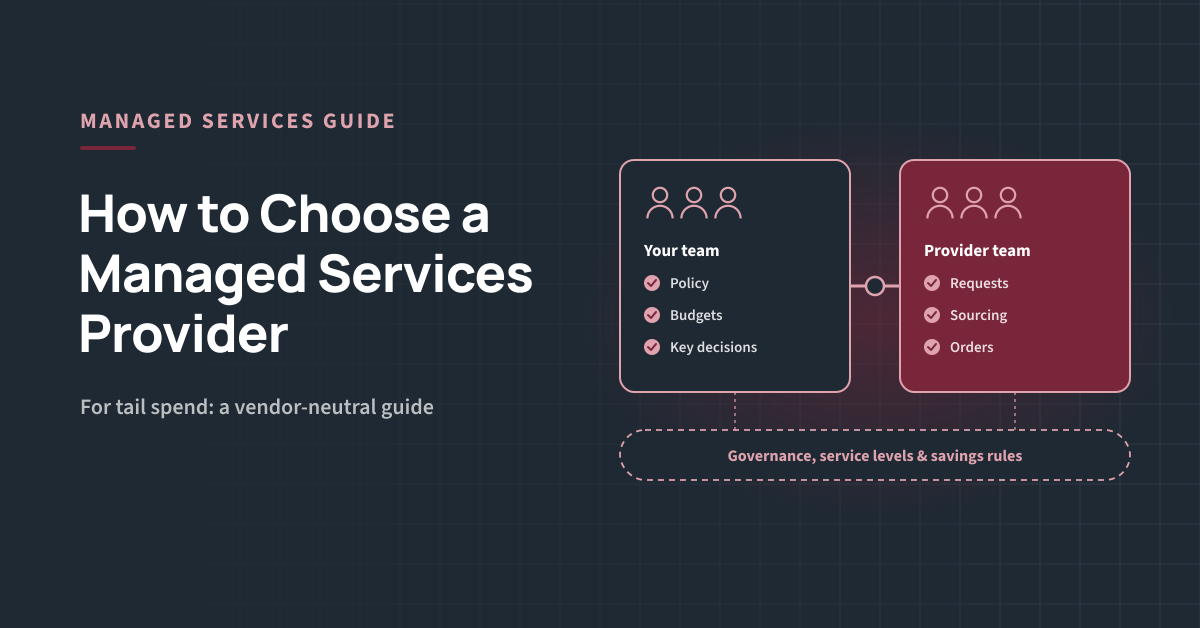
This vendor-neutral guide explains how to choose a tail spend managed services provider. It defines the service, lists what providers typically do, compares managed services with software and outsourcing, and covers scoping, an eight-step selection process, an evaluation scorecard, provider questions, pricing models, savings measurement, service levels, governance, contract terms, transition and risks.
A tail spend managed service is an arrangement in which an external provider’s buying team handles your low-value, high-volume purchases on your behalf, working inside your policies and usually inside your systems. The provider takes on the day-to-day work that your own team does not have time for: handling requests, finding suppliers, collecting quotes, placing orders, onboarding suppliers and reporting results. You keep ownership of policy, budgets and key decisions.
The model exists because tail spend is too fragmented to manage with a small internal team, but too important to leave unmanaged. Each purchase is small, yet together they carry real process cost, price leakage and supplier risk. A managed service adds buying capacity and category expertise without adding headcount.
This guide is vendor-neutral. It does not name or rank providers. It explains what tail spend managed services cover, when they make sense, how to scope and choose a provider, how pricing and savings measurement work, and which contract terms, service levels and governance arrangements protect you.
Scope varies by provider and contract, but most tail spend managed services include some or all of the following:
| Service | What it covers |
|---|---|
| Request handling (buy desk) | Receiving purchase requests, clarifying needs and routing them to the right channel |
| Spot buying and sourcing | Finding suppliers, collecting and comparing quotes, and recommending or placing orders |
| Catalogue and preferred supplier management | Setting up and maintaining catalogues, punch-out sites and preferred supplier lists |
| Supplier onboarding and checks | Collecting supplier details, running due diligence and sanctions screening |
| Purchase order processing | Creating and tracking purchase orders, chasing delivery |
| Invoice and query support | Resolving supplier and invoice queries linked to tail purchases |
| Supplier consolidation | Analysing recurring spend and moving it to fewer, preferred suppliers |
| Reporting and analytics | Regular reporting on volumes, cycle times, savings and compliance |
| Continuous improvement | Recommending policy, channel and category changes based on the data |
Most providers combine their buying team with technology, either their own platform or yours. Clarify early which systems the service will run in, because it affects data ownership, integration effort and what happens if you change provider.
Managed services sit between running tail spend yourself with software and handing it over entirely through outsourcing:
| Factor | Software | Managed services | Outsourcing |
|---|---|---|---|
| Who does the work | Your team | A provider’s team, inside your process | A partner, end to end |
| Control over decisions | High | High; you set policy and decision rights | Lower; governed by contract |
| Internal capacity needed | Highest | Moderate | Lowest |
| Typical scope | Tools and workflow | Defined activities, categories or value bands | Whole processes or categories |
| Best for | Teams with time to run a platform | Teams short on capacity that want to keep control | Organisations transferring defined, repeatable work |
If you are still deciding between these models, start with our comparison of software, managed services and outsourcing. For platform selection, see the Software Buyer’s Guide, and for full process transfer, see the Outsourcing Guide.
A managed service is usually worth considering when several of these are true:
It may be the wrong choice if your main problem is poor data or process rather than capacity, if your tail is small enough for catalogues and cards to handle, or if regulatory or security requirements make it hard for an external team to work in your systems.
| Model | How it works | Best for |
|---|---|---|
| Buy desk | The provider handles requests one by one through a shared service desk | High volumes of varied one-off requests |
| Tail category management | The provider manages selected tail categories end to end, including suppliers and catalogues | Recurring categories that need ongoing attention |
| Platform plus service | The provider’s team works through a tail spend platform, theirs or yours | Organisations wanting software and capacity together |
| Embedded team | Provider buyers work as part of your procurement team, often on site or dedicated | Organisations wanting close integration and knowledge retention |
| Multi-region service | A coordinated service across countries, currencies and languages | Global organisations with decentralised buying |
Many engagements combine models, for example a buy desk for one-off requests and category management for recurring spend.
Clear scope is the single biggest factor in a successful managed service. Decide these points before you go to market.
Define the categories, purchase types and value bands the provider will handle. Many organisations start with one-off goods and simple services below a set value, and keep specialist or high-risk categories in-house until the service is proven.
Write down what the provider may decide on its own, what needs your approval and what stays entirely with you. Typical examples: the provider may award spot buys within a value limit from approved suppliers; new suppliers, contract terms and policy exceptions need your approval.
Decide whether the service runs in your procurement and finance systems or the provider’s platform. Working in your systems keeps data and history with you; using the provider’s platform can be faster to start but makes exit planning more important.
List the countries, currencies, languages and time zones the service must cover, and any local requirements such as e-invoicing or supplier diversity rules.
Agree how employees will raise requests, how quickly they will hear back and how the service will be communicated. If requesters do not know the service exists or find it slow, they will go around it.
Choosing a provider is closer to hiring a team than buying a product. These eight steps help you judge the people, process and commercial terms, not just the proposal.
Agree what success looks like, such as more spend under management, faster cycle times, fewer suppliers or better pricing on one-off buys, and record your current baseline for each measure.
Map at least 12 months of tail spend by category, value band, supplier and region. Providers will price and plan around this data, so the better it is, the more accurate their proposals will be.
Use the scoping decisions above to write a clear scope document, including what is out of scope and how changes will be agreed.
Build a longlist from independent sources such as the Vendor Almanac, peer recommendations and analyst research, then shortlist three to five providers whose experience matches your categories, regions and size. The Vendor Fit Finder and Shortlist Builder can help.
Ask every provider to respond to the same set of real request scenarios, for example an urgent repair, a one-off event venue and a new software request, explaining how they would handle each, how long it would take and who would do the work.
Ask to meet the people who would actually run your service, not just the sales team. Assess their category knowledge, language coverage and how they would work with your procurement and finance teams.
Where possible, run a time-limited pilot on one business unit, region or set of categories, with agreed measures. A pilot shows how the provider performs on your requests, with your requesters and suppliers.
Finalise pricing, service levels, savings methodology, data ownership and exit arrangements before you sign. These terms decide how the relationship works when things go wrong.
Score every provider on the same criteria. The weights below are an example; adjust them to your priorities.
| Criterion | What to assess | Example weight |
|---|---|---|
| Category and tail expertise | Experience with your categories, purchase types and industry | 15% |
| Delivery team | Quality, stability and language coverage of the people who will run the service | 15% |
| Process and response times | How requests are handled, triaged and escalated | 10% |
| Technology and data | Platform, integration with your systems, reporting quality | 10% |
| Governance and control | Decision rights, transparency, audit trail | 10% |
| Savings methodology | How savings are defined, measured and validated | 10% |
| Commercial model | Pricing structure, incentives, total cost | 10% |
| Risk and compliance | Supplier checks, security, data protection, regulatory coverage | 10% |
| Transition and exit | Onboarding plan, knowledge transfer, exit support | 10% |
Example weights only. Score each criterion 1 to 5 and multiply by its weight.
Use these in your RFP and in meetings with the delivery team. Ask for examples and references rather than accepting general assurances.
Providers rarely publish prices, and quotes depend heavily on scope, volume and regions. What matters most is the incentive each model creates:
| Pricing model | How it works | Incentive it creates | Watch out for |
|---|---|---|---|
| Fixed management fee | An agreed fee for a defined scope | Predictable cost | Scope creep and service levels slipping |
| FTE-based | A fee per dedicated buyer or team member | Clear capacity | Paying for capacity whether or not it is used |
| Per transaction or request | A fee per request, sourcing event or order | Volume handled efficiently | Unpredictable cost; pressure to split requests |
| Percentage of managed spend | A share of the spend handled by the service | Bringing more spend under management | Fees growing with spend, not effort |
| Savings-based (gainshare) | A share of validated savings | Finding savings | How savings are defined and baselined |
| Hybrid | A base fee plus a variable or savings element | Balance of stability and performance | Complexity; make sure every element is measurable |
Whatever model you choose, compare the total cost over the full contract term, including transition costs, technology fees, change requests and any exit charges.
Savings claims are one of the most common sources of disagreement in managed services. Agree the method before the contract starts:
Service levels should measure what matters to requesters, procurement and finance. Set targets from your baseline and the pilot, not from a provider’s standard sheet.
| KPI | What it measures |
|---|---|
| Request acknowledgement time | How quickly requesters hear back |
| Request-to-order cycle time | How long it takes to place an order |
| Quotes per sourcing event | Whether one-off buys are competitively sourced |
| Spend under management | How much tail spend runs through the service and approved channels |
| Validated savings | Savings confirmed by finance using the agreed method |
| Supplier onboarding time | How quickly approved new suppliers can be used |
| PO compliance | Whether purchases follow the agreed process |
| Requester satisfaction | Whether employees prefer the service to workarounds |
| Data and reporting accuracy | Whether reported figures match your systems |
Link a small number of service levels to service credits or fee adjustments, and review the full set in regular governance meetings. Our guide to tail spend KPIs explains how to calculate the core measures.
| Forum | Frequency | Purpose |
|---|---|---|
| Operational check-in | Weekly | Open requests, escalations and urgent issues |
| Service review | Monthly | Service levels, volumes, savings and requester feedback |
| Quarterly business review | Quarterly | Performance trends, scope changes, improvement ideas |
| Strategic review | Yearly | Contract performance, future scope, renewal or change |
Name an owner on your side for the relationship, usually in procurement, with finance involved in service and business reviews. Without an internal owner, a managed service tends to drift from your priorities.
| Phase | Key activities |
|---|---|
| 1. Prepare | Confirm scope, decision rights, systems access and communication plan |
| 2. Knowledge transfer | Share policies, preferred suppliers, catalogues, approval rules and category knowledge |
| 3. Pilot | Run the service for one unit, region or category set; track agreed measures |
| 4. Roll out | Expand in waves, with requester communication and training |
| 5. Stabilise | Fix issues, tune service levels and reporting |
| 6. Improve | Review data, consolidate suppliers, adjust channels and scope |
Communicate the change clearly to requesters and suppliers. Tell employees how to raise requests and what to expect, and tell suppliers who they will be dealing with and how to quote purchase order numbers.
| Risk | How to manage it |
|---|---|
| Loss of internal knowledge | Keep an internal owner, require documentation and regular knowledge sharing |
| Dependence on one provider | Keep data in your systems where possible, and agree exit support in the contract |
| Inflated savings | Agree definitions and baselines, and have finance validate |
| Undisclosed supplier income | Require disclosure of rebates and commercial relationships |
| Requesters bypassing the service | Make the service the fastest route and measure satisfaction |
| Scope creep | Use a clear change process and review scope quarterly |
| Organisation | Typical need | What to prioritise |
|---|---|---|
| Smaller and mid-sized organisations | Buying support without hiring a team | Simple scope, flexible volume, clear pricing and quick start |
| Large organisations | Extra capacity alongside an existing procurement team | Integration with your systems, decision rights, category expertise |
| Global enterprises | Consistent buying across countries and languages | Multi-region coverage, local compliance, strong governance and reporting |
For the wider outlook, see our Tail Spend Management Trends to Watch in 2027.
Last reviewed: October 2026.
A tail spend managed service is an arrangement where an external provider’s buying team handles your low-value, high-volume purchases on your behalf, within your policies and usually your systems. The provider handles requests, sourcing, ordering and supplier onboarding, while you keep control of policy, budgets and key decisions.
Define goals and a baseline, analyse your tail, set scope and decision rights, shortlist providers from independent sources, issue an RFP with real request scenarios, meet the delivery team, run a pilot, and agree pricing, service levels, savings methodology and exit terms before signing.
Typical services include handling purchase requests, spot buying and sourcing, catalogue and preferred supplier management, supplier onboarding and checks, purchase order processing, invoice query support, supplier consolidation and reporting.
With managed services, the provider’s team works inside your process and you keep control of policy and decisions. With outsourcing, a partner takes over defined buying processes end to end under a contract, so more of the execution and day-to-day decisions move to the partner.
Common models are a fixed management fee, an FTE-based fee, a fee per transaction or request, a percentage of managed spend, a share of validated savings, or a hybrid. Providers rarely publish prices, so compare the incentive each model creates and the total cost over the contract term.
Agree definitions before the contract starts, separating cost reduction from cost avoidance, set the baseline each saving is measured against, avoid double counting, and have finance validate savings that affect budgets.
Typical service levels cover request acknowledgement time, request-to-order cycle time, quotes per sourcing event, spend under management, validated savings, supplier onboarding time, PO compliance and requester satisfaction. Set targets from your own baseline and pilot.
Running in your systems keeps data and history with you and makes changing provider easier. Using the provider’s platform can be quicker to start. If you use the provider’s platform, make sure the contract guarantees data access, export and exit support.
Yes. Many organisations use software for standard purchases and a managed service for complex, specialist or high-volume requests. Many providers now offer technology and buying teams together.
It depends on scope, systems access and regions. A focused pilot on one unit or category set can start relatively quickly, while multi-region services take longer. Ask providers for a transition plan and speak to reference clients about how long theirs actually took.
A concise briefing covering market developments, AI and technology, vendor changes, new research and procurement trends. Delivered periodically.
No daily news feed. Only developments worth knowing.