
A vendor-neutral decision guide to vendor consolidation for tail spend: which categories to consolidate first, how many suppliers to keep, how to choose them, which channels to use and whether to do it yourself or with a GPO or partner.
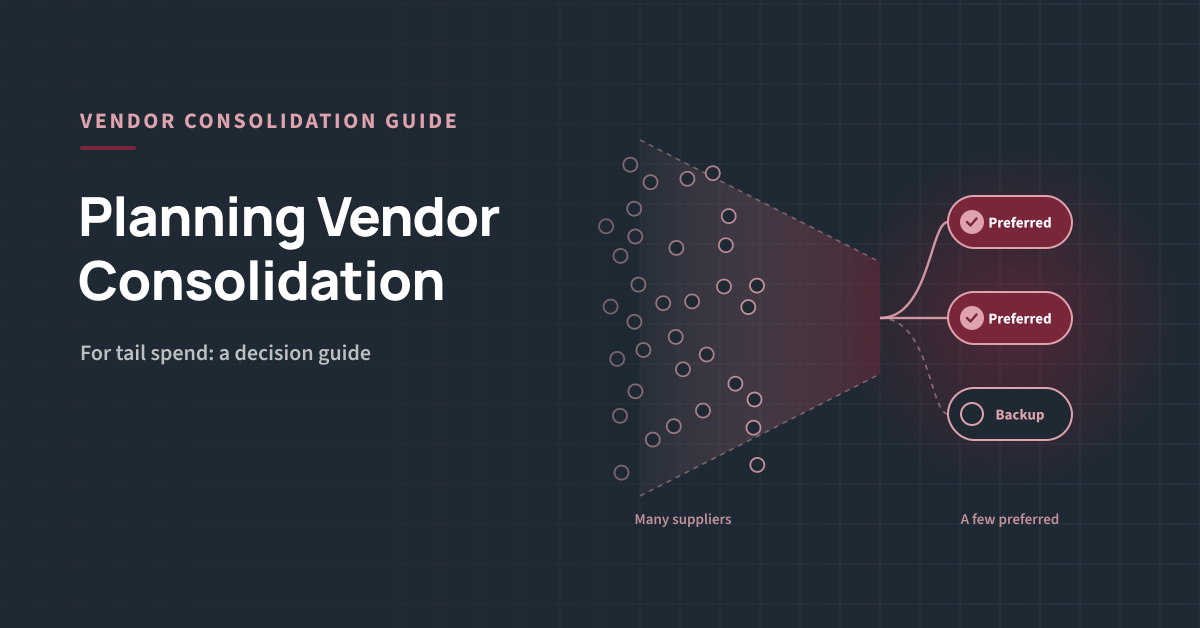
This vendor-neutral decision guide explains how to plan vendor consolidation for tail spend. It defines vendor consolidation and related terms, sets out benefits and risks, and walks through five decisions: which categories to consolidate first using a scoring template, how many suppliers to keep, how to choose preferred suppliers, which buying channel to use, and whether to work in-house, with a GPO or with a partner. It also covers a step-by-step plan, stakeholder buy-in, controls against supplier creep and KPIs.
Vendor consolidation is the practice of reducing the number of suppliers an organisation buys from by concentrating purchases with a smaller group of preferred suppliers. For tail spend, it means moving recurring low-value purchases away from many occasional suppliers and towards a few agreed suppliers, catalogues or channels with better prices, terms and controls.
Tail spend is where supplier lists grow fastest. Each one-off purchase can add a new supplier record, with its own onboarding, checks, invoices and payments. Over time, organisations end up buying the same things from many suppliers at different prices. Vendor consolidation reverses that drift.
This guide is a decision guide. Rather than just listing benefits, it walks through the five decisions every vendor consolidation strategy needs: which categories to consolidate first, how many suppliers to keep, which suppliers to choose, which channel to use and who should run the work. It also covers vendor consolidation services, risks, rollout, KPIs and how to stop the supplier list growing back. It is vendor-neutral and does not name or rank providers.
These terms are often used interchangeably, but they describe different stages of the same work:
| Term | What it means | Where it fits |
|---|---|---|
| Supplier or vendor rationalisation | Analysing the supplier base to decide which suppliers to keep, replace or remove | The analysis |
| Vendor consolidation (supplier consolidation) | Moving spend to fewer, preferred suppliers | The action and the result |
| Supplier optimisation | Improving performance, terms and collaboration with the suppliers you keep | What follows consolidation |
| Supplier deactivation | Removing dormant or duplicate supplier records from your systems | Housekeeping that supports consolidation |
In practice, most organisations run them together: rationalise to decide, consolidate to act, optimise to improve and deactivate to keep records clean.
Consolidation done badly can create new problems. Plan for these risks from the start:
| Risk | How to manage it |
|---|---|
| Over-dependence on one supplier | Keep at least one backup for anything critical; avoid single-sourcing essential items |
| Price creep after consolidation | Benchmark prices regularly, include price review clauses and re-tender periodically |
| Loss of specialist or local suppliers | Keep approved panels for specialist needs and regional suppliers where they add value |
| Service disruption during the switch | Phase the transition, test new suppliers and communicate early |
| Stakeholder resistance | Involve budget holders in supplier choice and explain the benefits for them |
| Conflict with small, local or diverse supplier goals | Set explicit goals and include qualifying suppliers in preferred tiers |
| Contract lock-in | Agree reasonable terms, exit rights and performance clauses |
Consolidation is usually worthwhile when you see these signs:
Be cautious in categories where requirements are genuinely unique each time, where local presence matters more than price, where only a few suppliers can deliver, or where supply risk makes dual sourcing essential.
A vendor consolidation strategy comes down to five decisions. Make them in this order, category by category:
| Decision | The question | What it produces |
|---|---|---|
| 1. Prioritise | Which categories should we consolidate first? | A ranked list of categories |
| 2. Size | How many suppliers should we keep in each category? | A target supplier structure by category |
| 3. Select | Which suppliers should we keep or appoint? | Preferred and approved suppliers |
| 4. Channel | How will employees buy from them? | Catalogues, agreements or marketplaces |
| 5. Resource | Who will do the work? | In-house, a GPO or a consolidation partner |
Score each tail category against a small set of criteria, then start with the highest scores. The template below is an example. Adjust the criteria and weights to your priorities.
| Criterion | What to look for | How to score (1 to 5) | Example weight |
|---|---|---|---|
| Supplier fragmentation | Number of suppliers for similar items or services | 5 = many suppliers for the same need | 25% |
| Category spend | Total annual spend in the category | 5 = high spend within the tail | 20% |
| Purchase frequency | How often the category is bought | 5 = frequent, recurring purchases | 15% |
| Standardisation potential | How easily requirements can be standardised | 5 = standard items or services | 15% |
| Supply risk (inverse) | How critical and hard to replace supply is | 5 = low risk to switch | 10% |
| Stakeholder readiness | Willingness of budget holders to change | 5 = supportive stakeholders | 10% |
| Contract position | Existing contracts and renewal dates | 5 = no lock-in, renewals due | 5% |
Example template. Multiply each score by its weight and add them up to rank categories.
Then place each category in a simple priority grid:
| Priority | Profile | Approach |
|---|---|---|
| Quick wins | High fragmentation, standard items, low risk | Consolidate first, often through catalogues or a single distributor |
| Major opportunities | High spend, recurring services, moderate complexity | Run a structured sourcing exercise and appoint preferred suppliers |
| Later | Lower spend or lower fragmentation | Review after quick wins are delivered |
| Handle with care | Critical, specialist or local-presence categories | Use approved panels rather than aggressive consolidation |
There is no universal right number. The goal is enough suppliers to protect supply, competition and coverage, and no more. These patterns are a useful starting point:
| Category type | Typical structure | Why |
|---|---|---|
| Standard goods (office, IT accessories, consumables) | One primary supplier or distributor, plus a backup | High standardisation; a catalogue or punch-out keeps buying simple |
| Recurring services (cleaning, couriers, printing) | Two or three preferred suppliers | Competition and coverage across sites |
| Specialist services (translation, testing, consultancy) | An approved panel | Different needs require different expertise |
| Critical supplies | At least two qualified suppliers | Protects continuity if one fails |
| Location-dependent services (repairs, facilities) | One or two per region | Local presence matters more than national scale |
Use tiers to keep the structure clear: preferred suppliers get most of the volume and appear first in catalogues and intake; approved suppliers can be used when preferred ones cannot meet the need; restricted suppliers need justification before use.
Choose preferred suppliers through a competitive process, such as a request for quotation or proposal, using criteria that matter for tail spend:
| Criterion | What to assess |
|---|---|
| Total cost | Prices, delivery and fees, rebates and payment terms, not just list price |
| Range and coverage | Breadth of products or services, and geographic coverage across your sites |
| Service and performance | Delivery reliability, responsiveness and quality |
| Ease of buying | Catalogue or punch-out support, ordering channels and account management |
| Invoicing and systems | PO matching, consolidated invoicing and e-invoicing capability |
| Risk and compliance | Financial stability, security, sanctions screening and certifications |
| Capacity | Ability to absorb extra volume without service dropping |
| Small, local or diverse supplier goals | Contribution to any supplier diversity or local spend targets |
Involve budget holders in the evaluation. Suppliers chosen with their input are far more likely to be used.
Appointing preferred suppliers only works if employees can buy from them easily. Choose the channel that fits each category:
| Channel | How it works | Best for | Watch out for |
|---|---|---|---|
| Preferred supplier agreements | Negotiated terms with named suppliers, used via intake or POs | Recurring services | Low usage if requesters do not know about them |
| Catalogues and punch-out | Pre-agreed items and prices inside your procurement system | Standard goods | Keeping catalogues current |
| Single distributor or master vendor | One supplier provides a broad range, sourcing from others behind the scenes | Wide ranges of low-value items | Price transparency and dependency |
| B2B marketplace | A business marketplace connected to your systems | Low-risk commodity items | Dynamic pricing; benchmark regularly |
| GPO or cooperative contract | Use of agreements negotiated by a group purchasing organisation | Organisations without scale of their own | Fees, fit and transparency of terms |
Whichever channel you use, make it the easiest route. An intake-to-procure front door, guided buying and preferred suppliers shown first in the buying flow do more for compliance than policy alone.
Vendor consolidation can be run in-house or with outside help. Vendor consolidation services typically take one of three forms:
| Approach | How it works | Best for | Watch out for |
|---|---|---|---|
| In-house | Your procurement team analyses spend, runs sourcing and sets up channels | Teams with capacity and category knowledge | Time; consolidation competes with other priorities |
| Group purchasing organisation (GPO) | You use contracts a GPO has negotiated on behalf of many members | Organisations without the scale to negotiate strong terms alone | Fees paid by members or suppliers, contract fit and transparency |
| Consolidation partner or managed service | A provider analyses spend, sources suppliers and sets up channels for you, sometimes running them afterwards | Organisations short on capacity or expertise | Savings definitions, supplier income disclosure and dependency |
Many organisations combine approaches, for example using GPO contracts for commodity categories and running their own sourcing for services. If you work with a partner, agree how savings are measured and ask whether the partner receives any rebates or fees from the suppliers it recommends. Our Managed Services Guide and Outsourcing Guide explain how to evaluate providers.
These illustrative examples show how the five decisions play out in common tail categories. They describe typical approaches, not benchmarks.
| Category | Starting point | Consolidated approach |
|---|---|---|
| Office supplies | Many sites ordering from local stationers and online retailers | One distributor with a punch-out catalogue and an agreed core range, plus a backup supplier |
| IT accessories | Monitors, cables and peripherals bought on cards from many retailers | A catalogue of standard items from one or two resellers, with card purchases blocked for those items |
| Courier and postage | Each office using its own courier accounts | Two preferred couriers with central accounts and consolidated invoicing |
| Facilities repairs | Different contractors called by each site | One or two approved contractors per region, with call-off terms and agreed rates |
| Training courses | Teams booking courses directly from many providers | An approved panel of providers with agreed rates, booked through intake |
| Printing and promotional items | Ad hoc orders from many local printers | One or two preferred suppliers with standard specifications and online ordering |
A vendor consolidation business case is stronger when it includes all sources of value, not just price:
Use your own data and illustrative scenarios, present the case jointly with finance, and set targets as improvements on your baseline. The Opportunity Calculator can help you size the opportunity.
Once the five decisions are made, run each category through these steps:
Gather at least 12 months of spend from AP, purchase orders, cards and expenses. Merge duplicate supplier records and classify spend to categories, so supplier counts and spend are accurate.
Apply the scoring template from Decision 1 and agree your first wave of categories with finance and budget holders.
Agree standard specifications, product lists or service scopes for each category. Standardisation is often where the biggest savings come from, because it lets more volume go to fewer suppliers.
Run a competitive process, evaluate against the Decision 3 criteria and appoint preferred and approved suppliers.
Set prices, price review rules, service levels, invoicing requirements, payment terms and exit rights.
Load catalogues, configure punch-out, update preferred supplier lists and set intake routing so requests go to the new suppliers by default.
Tell budget holders and requesters what is changing and why. Notify suppliers that will no longer be used, settle open orders and phase the switch to avoid disruption.
Block or deactivate suppliers that are no longer needed, so new purchases cannot drift back to them.
Track the KPIs below, review supplier performance and adjust the structure as needs change.
Supplier lists grow back naturally. These controls keep consolidation in place:
| KPI | What it shows |
|---|---|
| Active suppliers per category | Whether the supplier base is shrinking where intended |
| Share of category spend with preferred suppliers | Whether volume is actually moving to chosen suppliers |
| New suppliers added per month | Whether supplier creep is under control |
| One-time suppliers as a share of active suppliers | Whether one-off buying is reducing |
| Price variance for repeat items | Whether prices are becoming consistent |
| Preferred supplier performance | Whether service holds up after consolidation |
| Dormant supplier records deactivated | Whether the supplier master is being kept clean |
Record a baseline before you start. Our guide to tail spend KPIs explains how to calculate active supplier count and spend under management.
| Organisation | Typical situation | What to prioritise |
|---|---|---|
| Smaller and mid-sized organisations | Limited buying power and a small procurement team | GPO or cooperative contracts, marketplaces and a few preferred suppliers for quick wins |
| Large organisations | Many sites buying the same items from different suppliers | Category-by-category sourcing, catalogues and intake routing |
| Global enterprises | Fragmented supplier bases across countries | Global agreements where possible, regional suppliers where local presence matters, consistent governance |
Vendor consolidation is a strategy, not an operating model, so it works alongside whichever model you use to run tail spend. Software provides the catalogues, intake routing and analytics that keep consolidation in place. Managed services and outsourcing partners can run the analysis, sourcing and day-to-day buying. Our Software Buyer’s Guide, Managed Services Guide and Outsourcing Guide explain how to choose each, and our comparison of software, managed services and outsourcing explains how they differ.
Last reviewed: October 2026.
Vendor consolidation is the practice of reducing the number of suppliers an organisation buys from by concentrating purchases with a smaller group of preferred suppliers, catalogues or channels. For tail spend, it means moving recurring low-value purchases away from many occasional suppliers.
Vendor rationalisation is the analysis of which suppliers to keep, replace or remove. Vendor consolidation is the action and result of that analysis: moving spend to fewer, preferred suppliers.
A vendor consolidation strategy sets out which categories to consolidate first, how many suppliers to keep in each, which suppliers to appoint, which buying channels to use and who will do the work, together with risk controls, rollout plans and KPIs.
It depends on the category. Standard goods often need one primary supplier or distributor plus a backup, recurring services two or three preferred suppliers, specialist services an approved panel, and critical supplies at least two qualified suppliers.
Start with categories that score highly on supplier fragmentation, spend, purchase frequency and standardisation potential, and low on supply risk. Quick wins are usually standard goods bought from many suppliers, such as office supplies, IT accessories and consumables.
The main risks are over-dependence on one supplier, price creep after competition falls, loss of specialist or local suppliers, disruption during the switch, stakeholder resistance and contract lock-in. Backup suppliers, price reviews, phased transitions and clear contract terms reduce them.
Vendor consolidation services are external support for consolidation, typically from group purchasing organisations that provide pre-negotiated contracts, or from consolidation partners and managed service providers that analyse spend, source suppliers and set up buying channels.
A GPO can help organisations without the scale to negotiate strong terms alone, especially for commodity categories. Check how the GPO is funded, whether its contracts fit your needs and how transparent its pricing and supplier fees are.
Use a new supplier gate that requires a business reason, route requests to preferred suppliers through intake, apply card and marketplace controls, deactivate dormant suppliers regularly and move repeat spot buys into contracts or catalogues.
Track active suppliers per category, the share of category spend with preferred suppliers, new suppliers added per month, one-time suppliers, price variance for repeat items, preferred supplier performance and dormant records deactivated, against a baseline recorded before you start.
A concise briefing covering market developments, AI and technology, vendor changes, new research and procurement trends. Delivered periodically.
No daily news feed. Only developments worth knowing.