
Tail Spend software gives your procurement team a single platform for sourcing, guided buying, supplier management and workflow automation, run on systems you control rather than handed off to a provider.
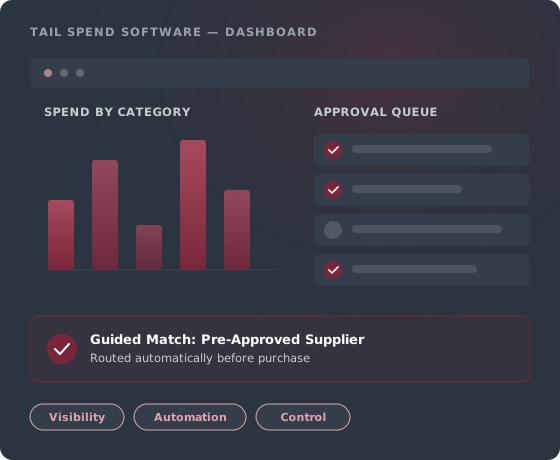
A platform your procurement team operates directly, rather than a service someone else runs on your behalf. It typically combines spend analytics, guided buying, sourcing automation and supplier management in one system, unlike Managed Services or Outsourcing, execution and data stay entirely in-house.
The category has moved quickly. Early platforms mostly added visibility through dashboards and reporting; many now use AI to classify incoming requests, recommend pre-approved suppliers and flag exceptions automatically, work that would otherwise scale with every new transaction rather than staying manageable.
Your team configures the rules, reviews exceptions and runs the platform day to day, no handoff to a provider.
Analytics, sourcing, workflow and supplier management live in a single platform instead of separate tools.
Spend data, supplier records and workflow history remain under your organisation's control at all times.
What a Tail Spend software platform typically covers, though coverage varies by vendor.
Dashboards and reporting that show where Tail Spend is going, by category, supplier and transaction type.
Directs buyers toward pre-approved suppliers and pricing before a purchase happens, rather than catching it after the fact.
Routes requests through the right approval chain automatically, based on category, value or risk.
A central record of active Tail Spend suppliers, contracts and performance.
Automatically categorises requests and flags policy exceptions or anomalies for review.
Enforces spending policies automatically and flags violations before they happen, not after.
You don’t have spare team capacity to configure and maintain a new platform — Managed Services adds that capacity for you.
You’d rather transfer execution entirely than manage a tool yourselves — Outsourcing removes that burden.
Your core problem is too many suppliers, not a lack of tooling — Vendor Consolidation addresses that directly.
Managed Services adds a provider’s team inside your process. Software keeps that work with your own team.
Outsourcing transfers execution to a provider end to end. Software keeps execution and control in-house.
Consolidation is a strategy, not a system, and can run alongside the software you already use.
Straight answers to the questions worth asking before you evaluate a provider.
Most platforms offer native connectors or APIs for common ERP and P2P systems. Ask for a list of existing integrations and whether custom integration work is included or billed separately.
Classification is typically manual, rule-based, or AI-assisted. Rule-based systems need manual updates as your supplier base changes; AI-assisted classification adapts automatically but should still allow manual override.
Look for a self-service workflow builder. If every change to an approval chain requires a support ticket to the vendor, that adds friction and cost over time.
This varies widely: some platforms only track suppliers, others handle onboarding, risk screening and performance tracking. Confirm which of these your team will still need to do manually.
Common models include per-user-seat pricing, a percentage of spend under management, or a flat platform fee. Ask how pricing changes as your transaction volume grows.
Implementation can range from a few weeks to several months depending on integration complexity. Ask for a realistic timeline based on your specific tech stack, not just the vendor’s best-case example.
The Vendor Fit Finder takes your primary challenge and preferred approach and returns a shortlist of relevant categories and providers in under a minute.