
A vendor-neutral guide to evaluating tail spend management software: the types available, the features that matter, how to run a selection, and how pricing and implementation work.
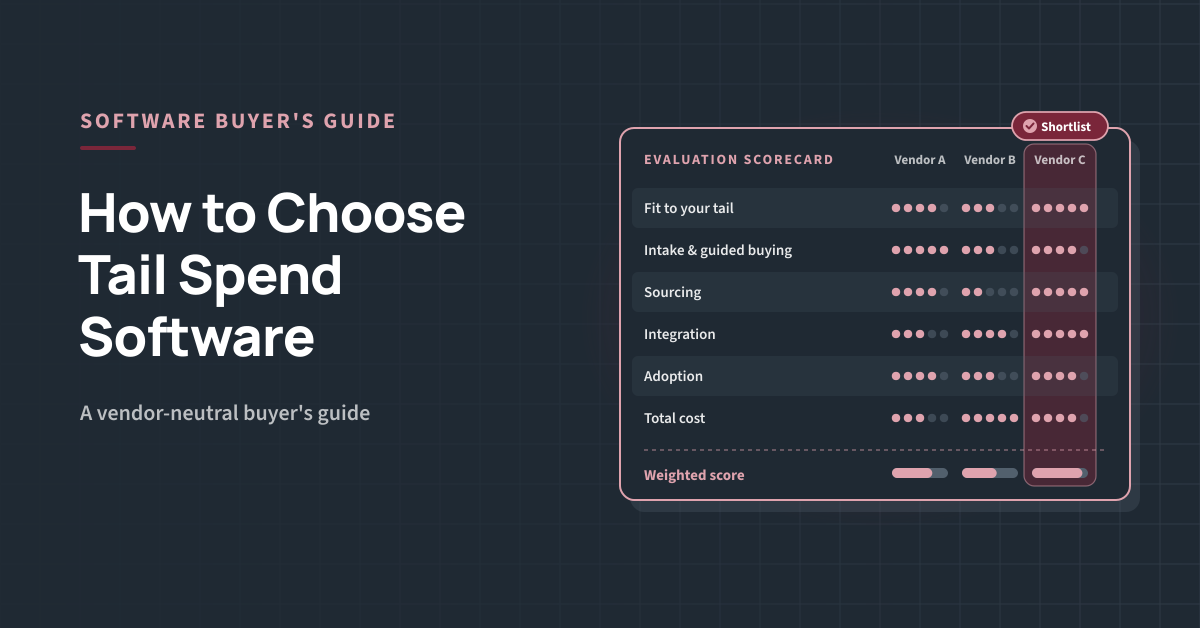
This vendor-neutral guide explains how to choose tail spend management software. It defines the software and its main types, lists the core features to evaluate, sets out a seven-step selection process with a weighted scorecard and vendor questions, explains common pricing models and total cost of ownership, and covers implementation, common mistakes and 2027 trends.
Tail spend management software is technology that helps organisations see, control and buy the many low-value, high-volume purchases that fall outside strategic sourcing. It typically combines spend visibility, a single front door for purchase requests, guided buying through catalogues and preferred suppliers, quick competitive sourcing for one-off buys, and controls that keep purchases compliant and visible to finance.
Tail spend is hard to manage by hand because it is spread across thousands of transactions, many suppliers and several payment routes: purchase orders, invoices without POs, P-cards and expense claims. No buyer has time to source each small purchase, so most of it is bought at list price, through whichever channel is easiest. Software changes that by making the compliant route the easiest one, and by automating the work that small purchases never justified.
This guide is vendor-neutral. It does not rank products. Instead, it explains what tail spend management software does, the types available, the features that matter, how to run a selection, how pricing works and how to avoid the most common mistakes, so you can choose the right fit for your organisation.
Not every organisation needs a separate tool. Tail spend capabilities are available in three forms, and the right choice depends on your existing systems, your volume and your team’s capacity.
| Option | What it is | Usually a good fit when |
|---|---|---|
| Modules in your existing suite | Tail spend features inside a source-to-pay, procure-to-pay or ERP platform you already own | Your suite’s intake and buying experience is good enough that employees actually use it |
| Dedicated tail spend software | A specialist platform focused on intake, guided buying, spot sourcing or tail analytics | Requests regularly bypass your current systems, or your suite lacks spot sourcing or easy intake |
| Software plus a managed service | A platform combined with a provider’s buying team | You lack the people to run the process, not just the tools |
Signs that dedicated tail spend management software is worth evaluating include:
If capacity, not technology, is your main constraint, read our Managed Services Guide and our comparison of software, managed services and outsourcing before you commit to a platform.
The market uses many overlapping labels. Most products fall into one or more of these categories, and many platforms now combine several:
| Category | What it does | Best for |
|---|---|---|
| Spend analytics and classification | Collects and classifies spend from AP, PO, card and expense data, and merges duplicate suppliers | Getting visibility before you change anything |
| Intake and orchestration | Gives every request one front door, applies policy and routes it to the right channel and approver | Stopping requests from bypassing procurement |
| E-procurement and guided buying | Catalogues, punch-out, preferred suppliers and approval workflows that steer employees to compliant options | Recurring purchases of standard items |
| Spot buying and autonomous sourcing | Runs quick competitive quotes for one-off purchases, sometimes with AI awarding within set limits | One-off goods and simple services |
| B2B marketplaces | Business marketplaces connected to your procurement system | Low-risk commodity purchases |
| Card and spend management | Virtual and physical cards with built-in limits, controls and reconciliation | Low-value purchases and subscriptions |
| AP automation | Invoice capture, matching and payment | Reducing the cost of processing tail invoices |
| Source-to-pay suites | End-to-end platforms with tail spend modules | Organisations standardising on one platform |
You rarely need all of these. Start from the problem you are solving, then match it to a category. If your problem is that nobody knows what the tail contains, start with analytics. If requests bypass procurement, start with intake. If one-off purchases are slow and unpriced, look at spot buying and autonomous sourcing.
Whatever type of tool you consider, these are the capabilities that decide whether tail spend management software works in practice. Use them to build your requirements list.
The software should pull in spend from every route, including AP, purchase orders, P-cards, expense claims and marketplaces, then clean supplier names and classify each transaction to a category. Check how it handles small, infrequent suppliers with vague descriptions, because that is where tail spend classification is hardest. Ask to see accuracy measured on your own data, by spend and by line count.
Look for a simple way for any employee to describe what they need, ideally in plain language, with the system working out the category, applying policy and routing the request. Intake is where most tail spend leakage can be stopped, so test it with real requesters, not just procurement staff.
Guided buying steers employees to catalogues, punch-out sites and preferred suppliers before they buy elsewhere. Check how easily procurement can create and update catalogues, and whether the tool suggests existing contracts before a new purchase starts.
For one-off purchases, the software should collect competing quotes quickly. More advanced tools run the whole request for quotation automatically and award within guardrails you set, such as value limits, approved supplier pools and escalation rules. Check how quotes are compared, how decisions are recorded and what happens when too few suppliers respond.
Tail spend brings in new suppliers every month. The software should make onboarding fast but controlled: capturing supplier details and documents, verifying bank details, and screening against sanctions and other risk lists. Low-risk suppliers should move through quickly, while flagged ones go to a reviewer.
Approvals should follow value and risk, so small, low-risk requests are not stuck in long approval chains. Look for configurable thresholds, rules that trigger extra checks (for example IT security for software or data protection for suppliers handling personal data), and support for policies such as no-PO-no-pay.
Approved requests should create purchase orders in the system finance already uses. Depending on your setup, look for invoice capture and matching, P-card or virtual card support, and e-invoicing compatibility in the countries where you buy, which is becoming mandatory in more of them.
The software should report the measures that show your programme is working: spend under management, active tail supplier count, PO compliance, request-to-order cycle time and card usage. Reports should be usable by non-specialists and filterable by category, channel and business unit.
AI now appears in most tail spend tools, from classification and plain-language intake to automated sourcing and agents. Separate what is live with customers today from what is on a roadmap, ask how accuracy is measured, and check that every automated decision is logged and explainable.
Integration with your ERP, P2P, AP, card programme, identity provider and supplier data sources usually decides how much effort implementation takes. Ask which integrations are pre-built, which need configuration and which need custom work.
Tail spend software only works if occasional buyers use it. Test the requester experience with real employees, check mobile access, and ask how the vendor supports change management and training.
A structured selection protects you from choosing on demo polish. These seven steps work for organisations of any size; scale the effort to the size of the decision.
Write down the problem you are solving in one or two sentences, for example “most tail requests bypass procurement” or “one-off purchases are slow and never competitively priced”. Then record a baseline for the KPIs you want to improve, so you can judge vendors against outcomes rather than features.
Analyse at least 12 months of spend from all payment routes. Define what counts as tail, segment it by purchase type (one-off, recurring, urgent, specialist, low-risk commodity) and note the categories and suppliers where problems concentrate. This tells you which capabilities matter most.
List the systems the new tool must work with and the constraints it must respect: data residency, security standards, approval policies, languages, countries and e-invoicing requirements. Decide early whether you need a standalone tool or a module that fits your existing suite.
Turn your problem, segments and constraints into a requirements list, then sort each item into must have, should have or nice to have. Keep the must-have list short. A long list of equal priorities makes every vendor look similar.
Start with a longlist from independent sources, such as the Vendor Almanac, peer reviews and analyst research, then narrow it to three to five vendors that meet your must-haves. The Vendor Fit Finder and Shortlist Builder can help match your profile to the right solution types and providers.
Give shortlisted vendors the same scripted scenarios based on your real requests, such as a catalogue order, a one-off service purchase and a new software request, and score each demo the same way. For the final one or two, run a proof of concept on a sample of your own spend data and requests.
Speak to customers similar to you in size and systems, and ask what implementation actually took. Compare the total cost of ownership over three to five years, not just the first-year subscription, and agree service levels, data access and exit terms before you sign.
The right tail spend management software also depends on your scale and complexity:
| Organisation | Typical situation | What to prioritise |
|---|---|---|
| Smaller and mid-sized organisations | Small or no procurement team; spend spread across cards, expenses and a few systems | Ease of use, quick setup, card and AP integration, simple approvals and pricing that suits a modest user base |
| Large organisations | A procurement team with an ERP or P2P platform, but tail requests bypass it | Intake on top of existing systems, guided buying, spot sourcing and strong integration |
| Global enterprises | Many entities, countries, currencies and languages | Multi-entity support, e-invoicing compliance by country, data residency, scalable classification and governance |
Smaller organisations often get the most value from a simple, all-in-one tool, while large enterprises usually add tail spend capabilities on top of the systems they already run.
Use a weighted scorecard so every vendor is judged on the same criteria. The weights below are an example only. Adjust them to reflect the problem you are solving.
| Criterion | What to assess | Example weight |
|---|---|---|
| Fit to your tail | Coverage of your main segments and categories | 15% |
| Visibility and classification | Accuracy on your data, supplier matching, reporting | 10% |
| Intake and guided buying | Ease of use for requesters, routing rules, catalogue management | 15% |
| Spot and autonomous sourcing | Speed, competition, guardrails, audit trail | 10% |
| Controls and compliance | Approvals, policy rules, supplier checks, card controls | 10% |
| Integration | Pre-built connections to your ERP, P2P, AP and cards | 15% |
| Adoption and usability | Requester experience, training, change support | 10% |
| Total cost of ownership | Subscription, implementation, integration and running costs over 3 to 5 years | 10% |
| Vendor viability and support | Customer references, roadmap, support model | 5% |
Example weights only. Score each criterion 1 to 5 and multiply by its weight.
Use these questions in RFPs and demos. Ask for evidence, such as a live demonstration on your data or a customer reference, rather than accepting a yes.
Pricing varies widely between vendors and is rarely published, so focus on how each model behaves as your organisation grows. Most tail spend and procurement software uses one of these models, or a combination:
| Pricing model | How it works | Watch out for |
|---|---|---|
| Per user | A fee per named or active user | Costs rising as more employees request purchases |
| Per requester | A fee per person who raises requests | Definitions of an active requester |
| Percentage of spend under management | A share of the spend processed through the platform | Fees growing with spend; negotiate caps or step-downs |
| Per transaction | A fee per purchase order, invoice or payment | Unpredictable costs in high-volume months |
| Flat or tiered platform fee | A fixed fee for a usage band | Moving into a higher tier as adoption grows |
| Hybrid | A base fee plus usage or module charges | Add-ons for AI, analytics or integrations |
Whichever model you choose, compare the total cost of ownership over three to five years. Include:
Tail spend software is easier to approve when the case is built on your own numbers. A strong business case covers four sources of value:
Present the case jointly from procurement and finance, use illustrative scenarios rather than vendor-promised savings, and include the full total cost of ownership. The Opportunity Calculator can help you size the opportunity before you go to market.
Implementation effort depends far more on integrations, data quality and scope than on the software itself. Plan in phases rather than a single big launch:
| Phase | Key activities | Owner |
|---|---|---|
| 1. Plan | Confirm scope, success measures, owners and timeline | Procurement and finance |
| 2. Prepare data | Clean supplier records, agree the category taxonomy, load catalogues | Procurement and IT |
| 3. Configure and integrate | Set policies, approval rules and routing; connect ERP, P2P and cards | Vendor and IT |
| 4. Pilot | Launch with one business unit or category, gather feedback, adjust rules | Procurement |
| 5. Roll out | Expand by unit or region with training and communication | Procurement and change team |
| 6. Optimise | Track KPIs, refine rules, add categories and automation | Procurement |
Adoption is the biggest risk. Make the new route the fastest one for requesters, communicate clearly and early, and measure how much tail spend enters through the platform from the first week.
Software gives your own team the tools to run tail spend. It is not the only model. Managed services add a provider’s buying team inside your process, and outsourcing transfers defined buying activity to a partner. Many organisations combine software with external capacity, split by type of purchase.
If you are unsure which model fits, our comparison of software, managed services and outsourcing explains the trade-offs, and our Managed Services Guide and Outsourcing Guide cover how to choose a provider for each.
For the full outlook, see our Tail Spend Management Trends to Watch in 2027.
Last reviewed: October 2026.
Tail spend management software helps organisations see, control and buy low-value, high-volume purchases that fall outside strategic sourcing. It typically combines spend visibility, a single front door for requests, guided buying through catalogues and preferred suppliers, spot sourcing for one-off purchases, and controls that keep spend compliant.
Define the problem and baseline KPIs, map your tail spend and systems, write prioritised requirements, build a shortlist from independent sources, run scripted demos and a proof of concept on your own data, then check references, total cost of ownership and contract terms.
Key features include spend classification, intake and guided buying, catalogues and punch-out, spot or autonomous sourcing, supplier onboarding and risk checks, value- and risk-based approvals, PO, invoice and card support, KPI reporting, explainable AI and pre-built integrations with your ERP and P2P systems.
Not always. If your suite’s intake and buying experience is easy enough that employees use it, its tail spend modules may be enough. A dedicated tool makes sense when requests regularly bypass the suite or it lacks spot sourcing or simple intake.
Pricing varies widely and is rarely published. Common models are per user, per requester, a percentage of spend under management, per transaction, a flat or tiered fee, or a hybrid. Compare total cost of ownership over three to five years, including implementation, integration and internal running costs.
It depends mainly on integrations, data quality and scope. A focused rollout with pre-built integrations can be quick, while projects with complex integrations and data cleansing take longer. Ask reference customers how long implementation actually took.
Procurement software covers the whole purchasing process, often including strategic sourcing and contracts. Tail spend software focuses on the many low-value, high-volume purchases outside strategic sourcing, with features such as easy intake, guided buying and fast spot sourcing.
Partly. AI can classify spend, route requests and run simple sourcing events within limits you set. People still set the rules, handle complex or high-risk purchases and remain accountable. Check which AI features are live today and how decisions are logged.
Choose software if your main problem is visibility and process and you have a team to run it. Choose a managed service if you lack capacity but want to keep control. Many organisations combine both, using software for standard purchases and a service for complex ones.
Track spend under management, active tail supplier count, PO compliance, request-to-order cycle time and card usage for eligible purchases. Record a baseline before implementation and review results monthly.
A concise briefing covering market developments, AI and technology, vendor changes, new research and procurement trends. Delivered periodically.
No daily news feed. Only developments worth knowing.