
Outsourcing transfers defined Tail Spend activities, transaction processing, purchase orders, invoice handling, to a provider end to end, including much of the day-to-day operational ownership your team currently holds.
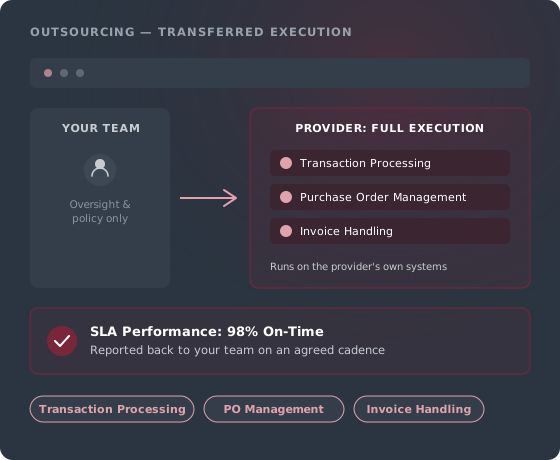
With Outsourcing, a provider takes over defined Tail Spend activities entirely, not just adding capacity within your process, but running the process itself, often on their own systems rather than yours. Unlike Managed Services, oversight moves largely to the provider under an agreed service level; unlike Software, your team isn’t the one operating a platform day to day.
Interest in outsourcing has grown as procurement teams face pressure to focus scarce internal capacity on strategic categories. For transaction-heavy, low-value Tail Spend work, outsourcing lets a specialist provider absorb the operational load entirely, using their own systems, staff and processes rather than requiring internal setup.
The provider runs the process end to end, typically on their own systems and with their own staff.
Specific activities, like transaction processing or invoice handling, transfer under an agreed scope and service level.
Internal capacity shifts toward strategic categories instead of high-volume operational work.
What a Tail Spend Outsourcing engagement typically covers, though scope varies by provider.
End-to-end handling of purchase requests, orders and confirmations for in-scope categories.
Manages new supplier setup and documentation on your behalf.
Creates, issues and tracks purchase orders against agreed policies.
Processes and reconciles invoices for outsourced transaction types.
Tracks SLAs, turnaround times and accuracy against the agreed contract.
Provides regular performance and spend reporting back to your team.
You want to keep hands-on control of execution — Software keeps that work with your own team.
You want added capacity but still want oversight inside your own process — Managed Services keeps you closer to the work.
Your core problem is too many suppliers, not too much transactional workload — Vendor Consolidation addresses that directly.
Software keeps execution and systems in your hands. Outsourcing transfers execution to a provider’s own systems and staff.
Managed Services adds people inside your process. Outsourcing transfers the process itself, often including the systems.
Consolidation reduces supplier count. Outsourcing transfers execution of transactions regardless of how many suppliers you use.
The Vendor Fit Finder takes your primary challenge and preferred approach and returns a shortlist of relevant categories and providers in under a minute.