
Managed Services adds a provider’s team inside your existing systems and policies, extending your procurement capacity for sourcing, buying and supplier management without changing who owns the process.
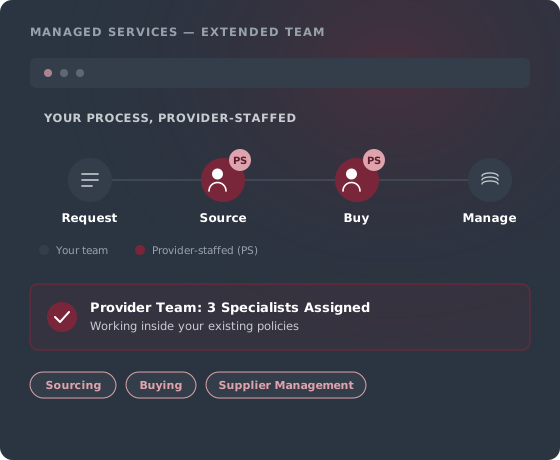
A provider’s team works within your existing systems, processes and policies, adding hands-on capacity for the day-to-day work of sourcing, buying and supplier management. Unlike Software, you’re not just getting a tool, you’re getting people. Unlike Outsourcing, you’re not handing over ownership, your team still sets the rules and the provider executes inside them.
Demand has grown alongside Tail Spend volume itself. As transaction counts climb faster than procurement headcount typically can, many organisations use Managed Services to add capacity for the categories and transaction types that don’t justify a full-time hire, without giving up control of how the work gets done.
The provider follows your existing policies and approval chains rather than replacing them.
You gain people-hours for sourcing, buying and supplier management without deploying a new platform.
Your team still owns strategy and final decisions; the provider executes the operational work.
What a Tail Spend Managed Services engagement typically covers, though coverage varies by provider.
Runs day-to-day sourcing activity, RFQs and supplier outreach for Tail Spend categories.
Places and manages orders within your approved supplier list and policies.
Handles supplier setup, performance tracking and day-to-day supplier communication.
Extends coverage to lower-value categories that don't justify a dedicated internal owner.
Provides regular visibility into activity, spend and compliance against your policies.
Flags and routes exceptions back to your team according to agreed thresholds.
Your process itself needs to change, not just get more capacity — Software gives your team the tools to redesign how work happens.
You want to transfer full ownership of Tail Spend execution — Outsourcing goes further than added capacity.
Your core problem is too many suppliers, not a lack of people — Vendor Consolidation addresses that directly.
Software gives your team tools to run Tail Spend yourselves. Managed Services adds a provider’s people to run it within your systems.
Outsourcing transfers ownership of execution entirely. Managed Services keeps you in control while adding capacity.
Consolidation reduces supplier count. Managed Services adds the people to manage the suppliers you already have.
Straight answers to the questions worth asking before you evaluate a provider.
Managed Services works inside your existing systems and policies, adding people rather than taking over ownership. Outsourcing typically transfers the process, and often the systems, to the provider entirely.
Yes. Managed Services adds execution capacity, not strategy or oversight. Your team still sets policy, approves exceptions and owns supplier relationships at a strategic level.
Most commonly, low-value, high-volume Tail Spend categories where dedicating a full-time internal resource isn’t cost-effective, though coverage varies by provider and contract.
Common models include a fixed monthly fee, a percentage of spend under management, or per-transaction pricing. Ask how pricing scales if your volume grows or shrinks.
This varies by contract. Some providers operate largely autonomously within agreed policies; others have team members who function almost like an extension of your own team, with regular check-ins.
Providers typically escalate anything outside agreed thresholds or policy back to your team, rather than making judgment calls outside their mandate.
The Vendor Fit Finder takes your primary challenge and preferred approach and returns a shortlist of relevant categories and providers in under a minute.