
Vendor Consolidation reduces the number of suppliers and contracts behind your Tail Spend, cutting administrative overhead and strengthening negotiating leverage, whether pursued on its own or alongside Software, Managed Services or Outsourcing.
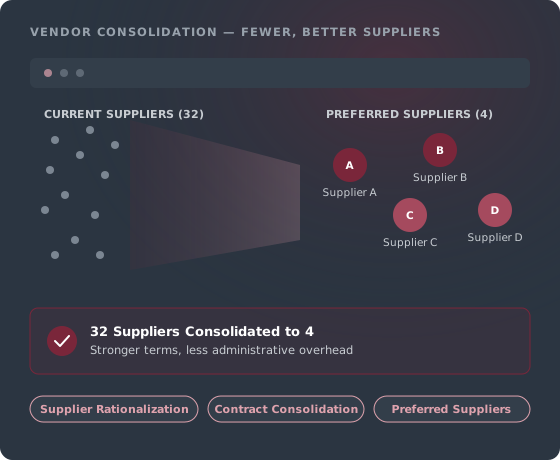
Vendor Consolidation is a strategy for reducing supplier sprawl, moving Tail Spend toward a smaller number of preferred, well-managed suppliers rather than adding a new system or team to run existing suppliers more efficiently. It’s often pursued alongside Software, Managed Services or Outsourcing rather than instead of them.
Supplier sprawl tends to accumulate quietly. Tail Spend spreads low-value purchases across many one-off or duplicate suppliers, each adding onboarding, compliance and administrative overhead of its own. Consolidation programs address that overhead directly, rather than making the existing supplier base easier to manage.
Spend is redirected toward a smaller set of vetted, preferred suppliers rather than spread thin.
No new platform or provider team is required, consolidation is a sourcing and policy decision.
Often paired with Software, Managed Services or Outsourcing rather than replacing them.
What a Tail Spend Vendor Consolidation programme typically involves.
Identifies overlapping, redundant or low-value suppliers to phase out or consolidate.
Combines multiple agreements into fewer, more favourable contracts.
Directs future purchasing toward a defined set of approved suppliers.
Concentrates volume with fewer suppliers to improve pricing and terms.
Reduces the number of suppliers to monitor for policy and contract compliance.
Lowers the ongoing administrative burden of onboarding and maintaining supplier records.
Your problem is transaction volume rather than supplier count — Software or Managed Services address that more directly.
You want to transfer execution rather than change your supplier base — Outsourcing goes further than consolidation alone.
You need day-to-day visibility and workflow tools, not just fewer suppliers — Software provides that directly.
Software gives your team tools to manage Tail Spend directly. Consolidation reduces the supplier base those tools would manage.
Managed Services adds people to run your existing suppliers. Consolidation reduces how many suppliers there are to manage.
Outsourcing transfers transaction execution. Consolidation changes which suppliers that execution runs through.
Straight answers to the questions worth asking before you start a consolidation programme.
The terms are often used interchangeably. Vendor Rationalization typically refers to the analysis and decision process; Vendor Consolidation describes the resulting programme of directing spend to fewer suppliers.
Yes, and it often is. Consolidation reduces how many suppliers there are to manage; Software or Managed Services provide the tools or capacity to manage them.
Common criteria include spend volume, service quality, contract terms, compliance history and category coverage. Most programmes start with a spend and supplier data analysis.
It can, if taken too far. Over-consolidating into a single supplier per category can increase supply risk. Most programmes aim for a small set of qualified suppliers per category, not just one.
This varies by scale, but most programmes run over several months to a year, since supplier transitions and contract renegotiations take time to execute without disrupting operations.
Not necessarily. Consolidation is primarily a sourcing and policy decision. Many organisations run it internally, though Software or Managed Services can support execution and tracking.
The Vendor Fit Finder takes your primary challenge and preferred approach and returns a shortlist of relevant categories and providers in under a minute.