
A vendor-neutral guide to choosing a procurement outsourcing partner for tail spend: what to outsource, what to keep, how to select a partner, and how pricing, contracts, transition, governance and exit should work.
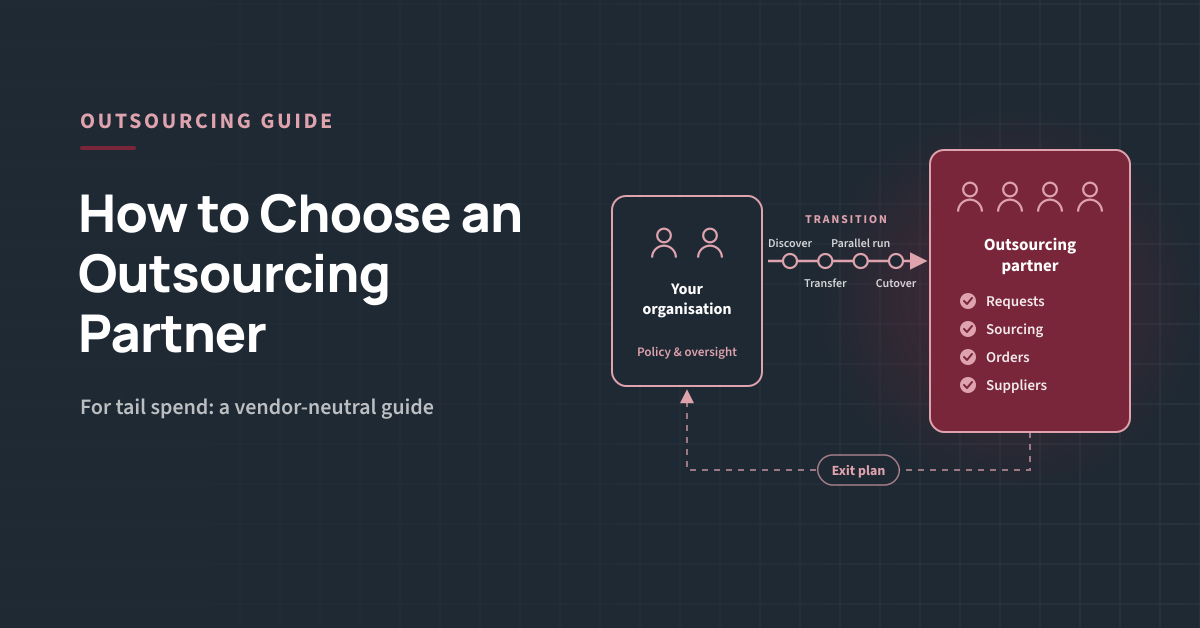
This vendor-neutral guide explains how to choose a procurement outsourcing partner for tail spend. It defines tail spend outsourcing and its scope levels, compares outsourcing with managed services and software, and covers the retained organisation, delivery models, the business case, a nine-step selection process, a partner scorecard, pricing models, contract structure, service levels, transition, governance, exit and risks.
Tail spend outsourcing is the transfer of defined tail spend processes to an external partner, which runs them end to end under a contract with agreed service levels. The partner typically handles requests, sourcing, ordering, supplier onboarding and related transactional work for the low-value, high-volume purchases that fall outside strategic sourcing. You keep accountability, policy and oversight, but the day-to-day execution moves to the partner.
Tail spend is a natural candidate for outsourcing. It is high in volume, repetitive in process and rarely a source of competitive advantage, yet it carries real process cost, price leakage and supplier risk. An outsourcing partner brings scale, established processes and buying capacity that most internal teams cannot justify for low-value purchases.
This guide is vendor-neutral. It does not name or rank partners. It explains what can be outsourced, when outsourcing makes sense, what you should keep in-house, how to select a partner, how pricing and contracts work, and how to manage transition, governance and exit.
Tail spend outsourcing can cover a narrow transactional slice or the whole tail. Most organisations choose one of these scope levels:
| Scope level | What is included | Typical for |
|---|---|---|
| Transactional | Purchase order creation, order follow-up, invoice and supplier query support | Organisations that want to free internal capacity but keep buying decisions |
| Tactical tail buying | A buy desk for requests, spot buying, quotes, catalogue maintenance and supplier onboarding | The most common tail spend outsourcing scope |
| Tail category management | Selected tail categories managed end to end, including suppliers, catalogues and consolidation | Recurring categories that need ongoing attention |
| End-to-end tail | All spend below an agreed threshold or outside strategic categories, from request to supplier performance | Organisations wanting the tail fully handled by a partner |
Start with a scope you can define clearly and measure. Many organisations begin with tactical tail buying and expand once the partner has proved itself.
| Factor | Software | Managed services | Outsourcing |
|---|---|---|---|
| Who does the work | Your team | A provider’s team, inside your process | A partner, end to end, using its own processes |
| Control | High | High; you keep decision rights | Shared; governed by contract and service levels |
| Internal capacity needed | Highest | Moderate | Lowest, plus a small retained team |
| Contract style | Software subscription | Service agreement for defined activities | Outsourcing contract with service levels, transition and exit |
| Best for | Teams with time to run a platform | Teams short on capacity that want to keep control | Organisations transferring defined, repeatable work at scale |
The difference between outsourcing and managed services is largely about who owns the process. With managed services, the provider works inside your process. With outsourcing, the partner runs the process, and you manage it through contract, service levels and governance. If you are still choosing a model, see our comparison of software, managed services and outsourcing, the Managed Services Guide and the Software Buyer’s Guide.
Outsourcing is usually worth considering when several of these are true:
It may be the wrong choice if your processes are undocumented and inconsistent, if the tail is small enough for catalogues and cards to handle, if security or regulatory rules prevent an external party from working in your systems, or if you want to build internal procurement capability rather than transfer it.
Outsourcing transfers execution, not accountability. Every successful outsourcing arrangement depends on a small retained team that manages the partner and protects your interests.
| Retained role | Responsibility |
|---|---|
| Policy owner | Owns procurement policy, approval rules and decision rights |
| Partner manager | Manages the contract, service levels and day-to-day relationship |
| Finance partner | Validates savings, monitors cost and reconciles reporting |
| Category experts | Own strategic categories and advise on specialist tail categories |
| Systems and data owner | Controls access, integrations and data quality |
| Risk and compliance lead | Sets supplier due diligence standards and audits compliance |
In smaller organisations, one or two people may cover several of these roles. What matters is that someone with authority owns each responsibility. Under-resourcing the retained organisation is one of the most common reasons outsourcing fails.
| Model | How it works | Consider when |
|---|---|---|
| Onshore | The partner’s team works in your country | Close collaboration, local language and supplier knowledge matter most |
| Nearshore | A team in a nearby country or similar time zone | You want lower cost with similar working hours |
| Offshore | A team in a lower-cost location further away | Processes are highly standardised and well documented |
| Multi-location | Teams across several locations, often combined with automation | You buy across many countries, languages and time zones |
| Dedicated vs shared team | A team working only on your account, or a shared pool | Dedicated teams retain knowledge; shared pools flex with volume |
Check where the team that handles your requests will actually sit, which languages they cover and how they handle local suppliers and requirements.
A credible case compares the full cost of running tail spend in-house with the full cost of outsourcing it, not a partner’s fee against one salary.
Use your own data and illustrative scenarios rather than partner-promised savings, and have finance review the case.
Selecting an outsourcing partner is a bigger commitment than buying software or a managed service, so the process needs more rigour, especially on due diligence, transition and exit.
Decide what outsourcing must achieve, for example lower process cost, more spend under management, faster cycle times or wider geographic coverage, and agree how each will be measured.
Prepare at least 12 months of tail spend data by category, value band, region and supplier, plus request volumes, current cycle times and current costs. Partners will design and price their solution from this data.
Set the scope level, value thresholds, categories, regions and systems, and decide which roles and decisions stay in-house. Write down what is out of scope.
Build a longlist from independent sources such as the Vendor Almanac, peer recommendations and analyst research. The Vendor Fit Finder and Shortlist Builder can help narrow it to partners suited to your scope and regions.
Use a short RFI to check experience, regional coverage, delivery locations, technology, security credentials and financial stability, then shortlist three to five partners.
Share the data pack and ask each partner for a solution design, a transition plan, proposed service levels and pricing. Include real request scenarios so you can compare how each partner would handle your work.
Meet the delivery team, visit or virtually tour the delivery centre, speak to reference clients with similar scope, and review financial stability, security certifications, data protection controls and subcontracting arrangements.
Agree pricing, service levels, service credits, savings methodology, change control, data ownership and exit terms. Involve legal, finance and the future partner manager.
Agree a detailed transition plan, with milestones, acceptance criteria, a parallel run and a communication plan, as part of the contract rather than after it.
Score every partner on the same criteria. The weights below are an example; adjust them to your priorities.
| Criterion | What to assess | Example weight |
|---|---|---|
| Tail spend experience | Clients, categories and scope similar to yours | 15% |
| Solution design | Quality of the proposed process, channels and automation | 10% |
| Delivery model and people | Locations, languages, team stability, dedicated or shared | 10% |
| Technology and data | Platforms, integration with your systems, reporting, data access | 10% |
| Service levels and governance | Proposed SLAs, reporting and governance model | 10% |
| Transition plan | Realism, milestones, parallel running and risk management | 10% |
| Commercial model | Pricing structure, incentives and total cost over the term | 15% |
| Risk, security and compliance | Certifications, data protection, supplier checks, financial stability | 10% |
| Exit and flexibility | Exit support, change control, ability to scale up or down | 10% |
Example weights only. Score each criterion 1 to 5 and multiply by its weight.
Use these in your RFI, RFP and due diligence. Ask for evidence and references rather than general assurances.
Outsourcing partners rarely publish prices, and quotes depend on scope, volume, regions and service levels. Compare models by the incentive and risk each one creates:
| Model | How it works | Who carries the risk | Watch out for |
|---|---|---|---|
| Input or FTE-based | A fee per dedicated person or team | You carry volume risk | Paying for capacity you do not use |
| Output or per transaction | A fee per request, order or sourcing event | Shared; partner carries productivity risk | Unpredictable cost; unit definitions |
| Fixed fee | An agreed fee for a defined scope and volume band | Partner carries most delivery risk | Change requests when volume or scope moves |
| Outcome-based | Payment linked to agreed results, such as cycle time or savings | Partner carries more performance risk | Measurement disputes; outcomes partly outside the partner’s control |
| Hybrid | A base fee plus volume or outcome-linked elements | Balanced | Complexity; make sure every element is measurable |
Hybrid models are common. According to Everest Group analysis, as cited by RethinkCX in 2026, the typical outsourcing agreement combines a base fee with outcome-linked components. Whichever model you choose, compare the total cost over the full term, including transition and exit.
Outsourcing contracts are usually built from a master agreement plus schedules. Make sure these elements are covered:
| Contract element | What it should cover |
|---|---|
| Master services agreement | Legal terms, liability, confidentiality, data protection, intellectual property |
| Statement of work | Scope, responsibilities on both sides, exclusions and assumptions |
| Service level schedule | Service levels, measurement, reporting and service credits |
| Pricing schedule | Fees, volume bands, indexation and how changes are priced |
| Governance schedule | Forums, attendees, frequency, escalation and dispute resolution |
| Transition schedule | Milestones, acceptance criteria, parallel running and responsibilities |
| Exit schedule | Exit assistance, data and documentation handover, timelines and costs |
Clauses that matter most for tail spend outsourcing include:
Set service levels from your baseline and the partner’s solution design, and link a small number to service credits.
| KPI | What it measures |
|---|---|
| Request acknowledgement time | How quickly requesters hear back |
| Request-to-order cycle time | How long it takes to place an order |
| Spend under management | How much tail spend runs through the outsourced process |
| Quotes per sourcing event | Whether one-off purchases are competitively sourced |
| Validated savings | Savings confirmed by finance using the agreed method |
| PO compliance | Whether purchases follow the agreed process |
| Supplier onboarding time and checks | How quickly and thoroughly new suppliers are set up |
| Requester satisfaction | Whether employees use and value the service |
| Reporting accuracy | Whether reported figures reconcile with your systems |
Our guide to tail spend KPIs explains how to calculate the core measures.
Transition is where most outsourcing risk sits. Plan it in phases with clear acceptance criteria:
| Phase | Key activities |
|---|---|
| 1. Discovery | Partner reviews processes, data, systems and volumes in detail |
| 2. Solution design | Confirm processes, channels, decision rights, service levels and reporting |
| 3. Knowledge transfer | Document policies, suppliers, catalogues and category knowledge; train the partner team |
| 4. Parallel run | Partner handles work alongside your team, with outputs checked before cutover |
| 5. Cutover | Partner takes over in waves by unit, region or category |
| 6. Stabilisation | Close support period to fix issues and tune service levels |
| 7. Steady state | Full service under normal governance and continuous improvement |
Communicate early with requesters and suppliers. Tell employees how to raise requests and what to expect, and tell suppliers who they will deal with, how to quote purchase order numbers and how invoices will be handled. Plan for a temporary dip in performance during cutover and protect critical purchases.
| Forum | Frequency | Purpose |
|---|---|---|
| Operational review | Weekly | Open requests, escalations, urgent issues |
| Service review | Monthly | Service levels, volumes, savings and requester feedback |
| Quarterly business review | Quarterly | Trends, improvement plans, scope and change requests |
| Executive review | Yearly | Contract performance, strategy, renewal and future scope |
Keep governance practical. Focus meetings on decisions and improvements, not just reporting, and make sure finance attends service and business reviews.
Plan your exit before you sign. A good exit plan protects you if performance falls short, the partner changes, or you decide to bring the work back in-house. It should include:
| Risk | How to manage it |
|---|---|
| Loss of control and knowledge | Keep a capable retained organisation and require documentation |
| Transition failure | Phase the transition, run in parallel and set acceptance criteria |
| Hidden costs | Price change control, transition and exit up front; model total cost |
| Inflated savings | Agree definitions and baselines; finance validates |
| Undisclosed supplier income | Require disclosure of rebates and supplier relationships |
| Poor requester adoption | Communicate early, make the service fast, track satisfaction |
| Lock-in | Keep data in your systems where possible and secure exit assistance |
| Organisation | Typical situation | What to prioritise |
|---|---|---|
| Mid-sized organisations | Limited procurement team and growing tail volume | Clear scope, flexible volume pricing, quick transition, simple governance |
| Large organisations | Established procurement with a large, decentralised tail | Integration with your systems, a strong retained team, robust service levels |
| Global enterprises | Tail spend across many countries, languages and entities | Multi-location delivery, local compliance, consistent governance and reporting |
For the wider outlook, see our Tail Spend Management Trends to Watch in 2027.
Last reviewed: October 2026.
Tail spend outsourcing is the transfer of defined tail spend processes, such as request handling, spot buying, ordering and supplier onboarding, to an external partner that runs them end to end under a contract with agreed service levels. You keep accountability, policy and oversight.
Agree objectives, build a data pack and baseline, define scope and your retained organisation, scan the market, run an RFI and an RFP with real scenarios, complete due diligence, negotiate commercials and contract terms, and agree a detailed transition plan before signing.
With managed services, a provider’s team works inside your process and you keep decision rights. With outsourcing, the partner runs the process end to end and you manage it through the contract, service levels and governance.
Options range from transactional work such as purchase order creation and invoice support, to tactical tail buying through a buy desk, to management of selected tail categories, to end-to-end handling of all spend below an agreed threshold.
Keep a retained organisation that owns policy and decision rights, manages the partner and contract, validates savings with finance, owns strategic categories, controls systems and data, and sets risk and compliance standards.
Common models are input or FTE-based fees, per-transaction pricing, fixed fees for a defined scope, outcome-based payments and hybrids that combine a base fee with variable elements. Compare the incentives and risks each creates and the total cost over the full contract term.
It depends on scope, regions, systems and data quality. Transitions usually move through discovery, solution design, knowledge transfer, a parallel run, cutover and stabilisation. Ask partners for a detailed plan and check timelines with reference clients.
Key risks include loss of control and knowledge, transition failure, hidden costs, inflated savings claims, undisclosed supplier income, poor requester adoption and lock-in. A strong retained team, clear contract terms and a planned exit reduce them.
Focus on scope and decision rights, service levels and service credits, change control, savings methodology, data ownership, supplier income disclosure, subcontracting, benchmarking rights, termination and exit assistance priced into the original contract.
Yes, if you plan for it. Agree an exit plan at signature, secure exit assistance, keep ownership of data, documentation and catalogues, and maintain a retained team with enough knowledge to take the work back.
A concise briefing covering market developments, AI and technology, vendor changes, new research and procurement trends. Delivered periodically.
No daily news feed. Only developments worth knowing.