
Most procurement teams know where their strategic spend goes. The tail is different. It is made up of hundreds or thousands of small purchases, spread across a long list of suppliers and often bought outside agreed channels. Each purchase looks too small to matter, but together they carry real cost, real risk and a lot of administrative effort.
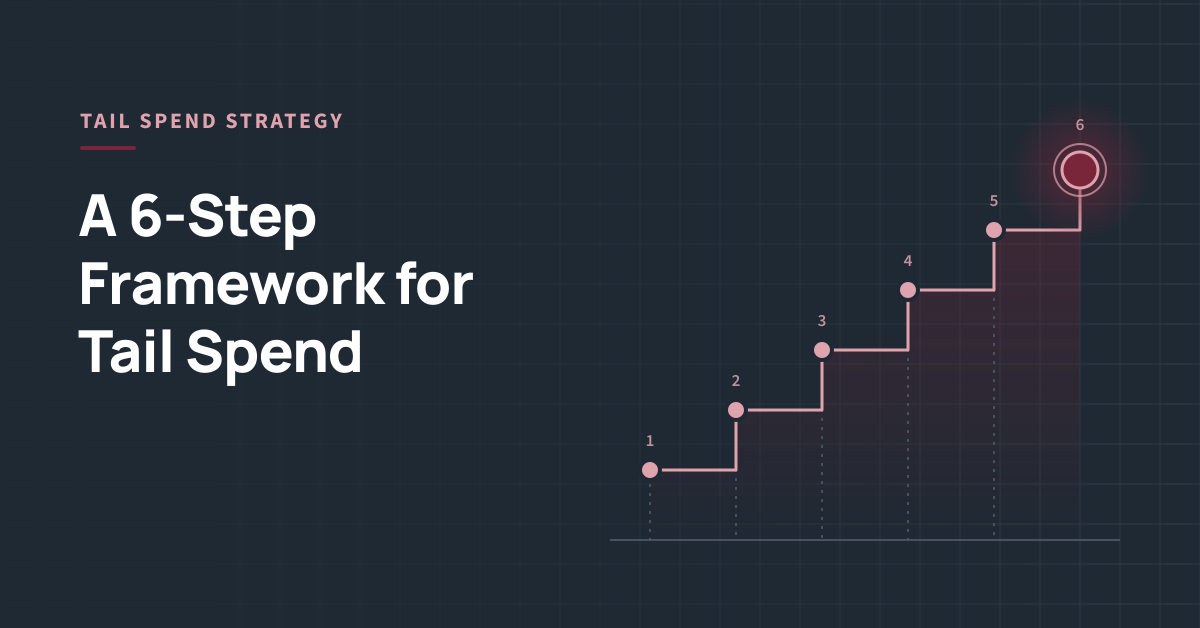
A tail spend strategy gives that spend a structure. This guide sets out a six-step framework you can apply whatever your size or systems: define your tail, get visibility of it, segment it, route each segment to the right buying channel, set clear policy, and track the KPIs that show it is under control.
What Is a Tail Spend Strategy?
A tail spend strategy is a plan for managing the many low-value, high-volume purchases that fall outside strategic sourcing. It defines which spend counts as tail, groups it by type, routes each group to the right buying channel, sets clear policy, and measures results so the spend stays visible and controlled.
Key Takeaways
- Tail spend is not one problem. Different types of purchase need different buying channels.
- Visibility comes first. You cannot segment or control spend you cannot see across AP, PO, P-card and expense data.
- The best policy makes the compliant route the easiest route for buyers.
- Procurement and finance should own the strategy together.
- Track a small set of KPIs: spend under management, active supplier count, PO compliance and cycle time.
Why Tail Spend Resists Control
The tail is hard to manage for structural reasons rather than through anyone’s negligence. Knowing these reasons helps you design a strategy that works with them instead of against them.
- Fragmentation. Spend is spread thinly across many categories, cost centres and suppliers, so no single buyer or category manager sees the whole picture.
- Maverick buying. When the approved route is slow or unclear, people buy what they need directly, on a card or on expenses. Each purchase is reasonable on its own, but together they bypass agreed terms.
- Many one-off suppliers. A large share of tail suppliers are used once or twice. Each still needs onboarding, master data, due diligence and payment, so the admin cost per supplier is high.
- Too small to source. Individual purchases rarely justify a full sourcing exercise, so they are never negotiated or consolidated.
- Scattered data. Tail transactions sit in the AP ledger, P-card statements, expense systems and sometimes marketplace accounts, often with inconsistent supplier names and no category codes.
A good strategy accepts that the tail will always be large and varied. The aim is not to source every purchase. It is to make sure every purchase goes through a channel that is fit for its type.
Step 1: Define Your Tail
There is no universal definition of tail spend, so the first step is to write one for your organisation. Use three lenses together:
- Spend threshold. Set a value below which a purchase or supplier counts as tail, for example annual spend per supplier under a figure that suits your size. A threshold is simple to apply, but on its own it can miss patterns.
- Supplier count. Look at how many suppliers sit below the threshold. A long list of low-spend suppliers is the clearest sign of a tail that needs attention.
- Pareto view. Rank suppliers by annual spend and plot the cumulative total. The point where the curve flattens is a natural cut-off. This is often described as the 80/20 rule, but your own data should set the line, not the rule of thumb.
Then apply two adjustments. Exclude low-value spend that already sits under a strategic contract, because it is managed. Add a risk flag for any small supplier that handles sensitive data, works on site or affects safety, because low value does not always mean low risk.
The output of Step 1 is a short written definition, agreed by procurement and finance, that everyone uses when they talk about tail spend.
Step 2: Get Visibility
You cannot manage spend you cannot see. Bring every source of tail transactions into one view:
- Collect the data. Pull at least 12 months from the AP ledger, purchase orders, P-card statements and expense claims, plus any marketplace or punch-out accounts.
- Clean supplier names. Merge duplicates and variants (“ABC Ltd”, “ABC Limited”, “ABC Ltd UK”) so each supplier appears once.
- Classify to a taxonomy. Assign every line to a category, using a standard such as UNSPSC or your own category tree. Keep the top levels simple enough for finance and budget holders to read.
- Apply your definition. Tag each supplier and transaction as tail or non-tail, using the rules from Step 1.
- Set a refresh cycle. A one-off analysis goes stale quickly. Refresh the view monthly or quarterly so you can see whether the tail is shrinking.
Spend analytics and classification tools can do much of this work automatically, especially at high volumes. Our guide to tail spend software explains what these platforms typically cover.
Step 3: Segment Your Tail
With clean data, group tail purchases by how they are bought, not just by category. Five segments cover most organisations:
| Segment | What it looks like | Typical examples |
|---|---|---|
| One-off | Bought once, unlikely to repeat | Event venue, a single piece of specialist furniture |
| Recurring | Same items bought regularly from different suppliers | Office supplies, IT accessories, consumables |
| Urgent | Needed fast, often to keep operations running | Emergency repairs, replacement parts |
| Specialist | Low value but needs expertise to specify or buy | Lab tests, niche software licences, technical services |
| Low-risk commodity | Standard items where price and convenience matter most | Stationery, cleaning supplies, small hardware |
Segmenting this way matters because each segment fails for a different reason. Recurring purchases leak value through lack of consolidation. Urgent purchases bypass process because the process is too slow. Specialist purchases need expert help rather than a cheaper channel. The next step uses these segments to pick the right channel for each.
Step 4: Match Each Segment to a Buying Channel
This is where the strategy turns into action. Each segment gets a default channel, so buyers know where to go and procurement knows where its effort is needed.
| Segment | Best-fit channel | Why it works |
|---|---|---|
| One-off | Spot-buy desk or marketplace | Gets competitive quotes quickly without a full sourcing exercise |
| Recurring | Catalogue or punch-out with preferred suppliers | Locks in agreed prices and cuts the number of suppliers |
| Urgent | P-card with clear limits, or a fast-track spot buy | Keeps speed while keeping the spend visible |
| Specialist | Managed service or expert buyer support | Adds expertise the requester does not have |
| Low-risk commodity | Marketplace, catalogue or P-card | Lowest process cost for low-risk items |
Most organisations end up with a mix of channels run through one or more management models. Software lets your own team run guided buying and spot sourcing. A managed service adds a provider’s buyers to handle volume. Outsourcing transfers defined buying activity to a partner. Vendor consolidation reduces the supplier list behind recurring categories. The right combination depends on your team’s capacity, your systems and how much control you want to keep in-house.
Step 5: Set Policy and Guided Buying Rules
Policy tells people which channel to use; guided buying makes that channel the easiest one to use. A short, clear policy beats a long one that nobody reads. Cover these points:
- Approval thresholds. Set value bands for who approves what, and keep approvals light for low-value, low-risk purchases.
- Channel rules. If an item is in the catalogue, buy it from the catalogue. If it is not, use the spot-buy route.
- Preferred supplier lists. Name preferred suppliers for recurring categories and make them visible in the request flow.
- P-card controls. Set transaction and monthly limits, and block merchant categories that should go through other channels.
- No PO, no pay. Require a purchase order before an invoice is paid, with a short, defined list of exceptions such as utilities.
- New supplier gate. Require a justification and basic due diligence before a new tail supplier is added.
Then build these rules into the request process. A guided buying flow asks what the requester needs and sends them straight to the right channel, so they don’t need to know the policy by heart. When the compliant route is also the fastest route, maverick buying falls on its own.
Step 6: Measure What Matters
A few KPIs, reviewed regularly, show whether the strategy is working. Record a baseline before you change anything, so you can show progress against your own starting point.
| KPI | What it measures | What good looks like |
|---|---|---|
| Spend under management | Share of tail spend that goes through approved channels | Rising steadily quarter on quarter |
| Active supplier count | Number of tail suppliers paid in the last 12 months | Falling as recurring spend consolidates |
| PO compliance | Share of tail invoices with a matching purchase order | Rising towards your no-PO-no-pay target |
| Cycle time | Time from request to order for tail purchases | Falling, or stable as controls tighten |
Review these monthly in a simple dashboard and quarterly with finance. If spend under management rises but cycle time rises too, the controls may be adding friction that will push buyers back to workarounds. Read the KPIs together, not one at a time.
Common Mistakes to Avoid
- Treating the tail as one thing. A single rule for all tail spend either over-controls urgent purchases or under-controls recurring ones. Segment first.
- Buying a tool before fixing the data. Software works best on clean, classified data. Steps 1 and 2 make any later investment more effective.
- Adding friction instead of control. Extra approval layers on small purchases slow buyers down and push them towards cards, expenses and workarounds.
- Leaving it to procurement alone. Finance and AP control payments, cards and supplier set-up. Without them, policies like no-PO-no-pay are hard to enforce.
- Measuring savings only. Savings matter, but in the tail much of the value comes from fewer suppliers, lower process cost and lower risk. Track those too.
- Treating it as a one-off project. New suppliers appear every month. Without a refresh cycle and regular KPI reviews, the tail grows back.
Where to Start
You don’t need all six steps in place at once. Start by writing your definition and building a single view of your data. The rest of the strategy builds on those two steps. Then pick the segment with the clearest problem, often recurring purchases spread across too many suppliers, and fix its channel first. A visible early result makes it easier to win support for the next segment.
See where your organisation stands. The Tail Spend Management Assessor asks four quick questions and points you to the management approach that fits your profile. When you know which approach fits, the Vendor Almanac helps you find providers that offer it.
Frequently Asked Questions
What counts as tail spend?
Tail spend is the low-value, high-volume spend that sits outside strategic sourcing and negotiated contracts. Each organisation sets its own definition, usually by combining a spend threshold per supplier with a ranked, cumulative view of supplier spend.
Who should own the tail spend strategy?
Procurement usually leads, but the strategy works best when finance and accounts payable own it jointly. Procurement manages channels and suppliers. Finance and AP control payment rules, P-cards and supplier set-up, which are needed to enforce the policy.
How long does it take to see results?
Visibility and quick wins, such as moving recurring purchases to a catalogue, can show within the first few months. Measures like active supplier count and spend under management change more slowly and are best judged over a full year against your baseline.
Do I need software to manage tail spend?
Not always. Smaller organisations can make real progress with clean data, a clear policy and good use of P-cards and catalogues. Software becomes more valuable as volumes grow, when manual classification, approvals and spot sourcing take up too much of the team’s time. Compare the options on our tail spend software page, or use the Vendor Fit Finder to see which approach suits you.