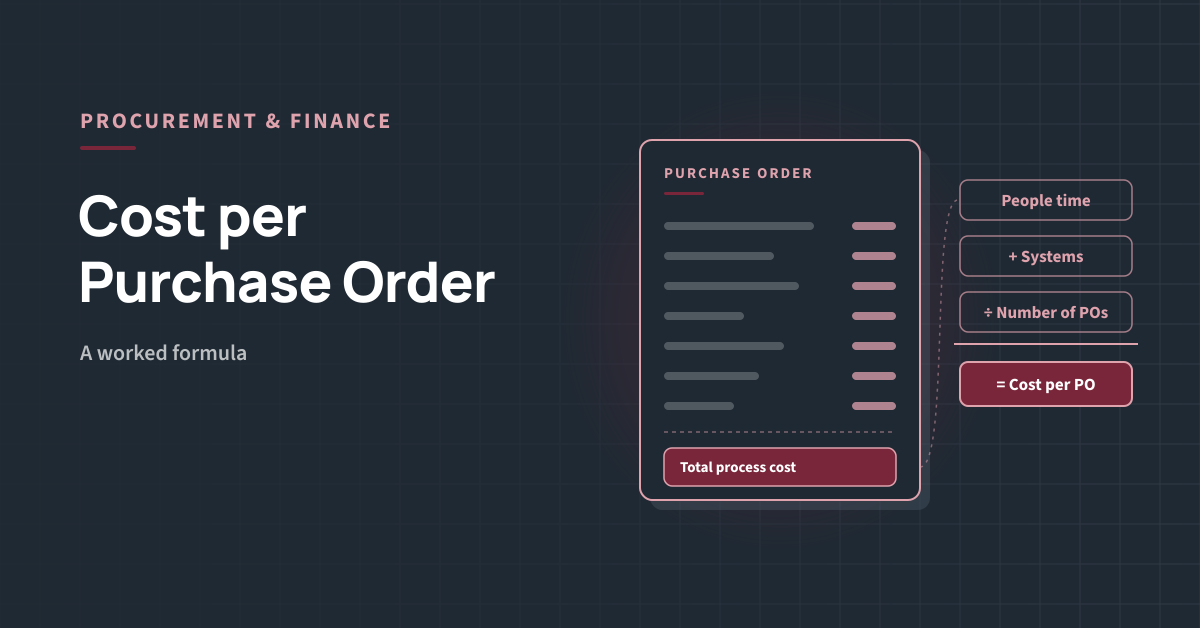
Cost per purchase order is one of the most useful numbers in procurement and finance, and one of the least often measured. It tells you what it costs your organisation to process a single purchase, from the first request to the final payment. For tail spend, where purchases are small and frequent, that number can change how you see the whole category.
This guide explains what cost per PO includes, gives you a simple formula, works through an example step by step, and shows how to use the result to size the cost of your tail and build a business case.
What Is Cost per Purchase Order?
Short answer
Cost per purchase order is the average internal cost of processing one purchase, from request and approval through ordering, receipt, invoice matching and payment. You calculate it by adding the people time, system costs and overheads involved in the process, then dividing by the number of purchase orders processed in the same period.
Key Takeaways
-
- Cost per PO measures process cost, not the price of what you buy.
-
- Decide your scope first: request to PO only, or request to payment. For tail spend, the end-to-end figure is more useful.
-
- Include requester and approver time, not just procurement and accounts payable. It is often the largest share.
-
- Your own figure, tracked over time, is more useful than an external benchmark.
-
- Multiply cost per PO by your number of tail POs to see the hidden process cost of the tail.
Step 1: Decide What to Include
Published cost-per-PO figures vary widely, mainly because organisations measure different things. Before you calculate anything, decide your scope and write it down.
| Scope |
What it covers |
When to use it |
| Request to PO |
Requisition, approval and purchase order creation |
Measuring procurement efficiency on its own |
| PO to payment |
Receipt, invoice processing, exceptions and payment |
Measuring accounts payable efficiency |
| Request to payment (end to end) |
Every step from the first request to the final payment |
Sizing the true cost of tail spend and building a business case |
For tail spend, use the end-to-end scope. It captures the full cost that each small purchase triggers, which is the point our guide to
the real cost of tail spend makes about transaction cost.
Step 2: Use the Formula
Cost per PO = (People cost + System cost + Other direct costs) ÷ Number of POs
All figures for the same period, usually one year.
Each part of the formula is built from data you probably already have:
| Input |
How to work it out |
Where to find the data |
| People cost |
Time spent on each step × fully loaded hourly cost of the person doing it |
Process walkthroughs, time sampling, HR or finance salary bands |
| Fully loaded hourly cost |
(Salary + benefits + employer taxes + overhead share) ÷ productive hours per year |
Finance or HR |
| System cost |
Annual cost of P2P, e-procurement and the relevant share of ERP licences and support |
IT and procurement budgets |
| Other direct costs |
Printing, postage, bank charges, outsourced AP fees |
Finance ledger |
| Number of POs |
Purchase orders created in the same period |
Procurement or ERP reports |
Step 3: Work Through an Example
The example below uses
illustrative figures only, not a benchmark. Replace each number with your own. The method works in any currency.
First, map each step of the process, who does it, how long it takes on average, and that person’s fully loaded hourly cost:
| Process step |
Who |
Minutes |
Hourly cost |
Cost per PO |
| Find a supplier and raise the request |
Requester |
30 |
$50 |
$25.00 |
| Approve the request |
Line manager |
10 |
$70 |
$11.67 |
| Review the request and create the PO |
Buyer |
20 |
$55 |
$18.33 |
| Confirm goods or services received |
Requester |
5 |
$50 |
$4.17 |
| Process and match the invoice |
AP clerk |
15 |
$40 |
$10.00 |
| Resolve exceptions (average across all POs) |
AP clerk |
10 |
$40 |
$6.67 |
| Make and reconcile the payment |
Finance |
5 |
$45 |
$3.75 |
| People cost per PO |
|
95 |
|
$79.58 |
Illustrative figures. Exception time is averaged across all POs, including those with no exceptions.
Next, add system costs. In this example, the organisation spends $120,000 a year on its procurement and AP systems and processes 20,000 POs a year. That adds $6.00 per PO.
$79.58 people cost + $6.00 system cost = $85.58 per PO
Notice where the cost sits. In this example, the requester and line manager account for more of the cost than procurement or AP. That is common, and it is why calculations that only count the procurement and AP teams tend to understate the real figure.
Step 4: Apply It to Your Tail
Cost per PO becomes most useful when you multiply it by the volume of tail purchases. Continuing the illustrative example:
| Calculation |
Illustrative figure |
| Tail POs per year |
12,000 |
| Cost per PO |
$85.58 |
| Annual process cost of tail POs (12,000 × cost per PO) |
$1,027,000 |
| Average value of a tail PO |
$400 |
| Process cost as a share of average tail PO value |
21% |
Illustrative figures only. Use your own PO counts and average values.
This is the kind of finding that gets attention in a budget review. When the cost of processing a purchase is a large share of what was bought, moving that purchase to a lower-cost channel saves more than any price negotiation would.
Common Mistakes to Avoid
-
- Leaving out requester and approver time. It is spread across the business and easy to miss, but it is real cost.
-
- Using salary instead of fully loaded cost. Benefits, employer taxes and overheads can add a large share on top of salary.
-
- Ignoring exceptions. Price mismatches, missing receipts and supplier queries take far longer than clean invoices. Average them across all POs.
-
- Mixing scopes. Comparing a request-to-PO figure with an end-to-end figure gives a misleading result.
-
- Measuring once. Recalculate every year, or after a process change, so you can show the effect of improvements.
How to Reduce Cost per PO
Once you know your figure, these changes usually bring it down for tail purchases:
-
- Move low-value purchases to P-cards. Cards remove the PO and invoice steps for small, low-risk buys.
-
- Use catalogues and punch-out. Pre-agreed items and prices cut supplier search and review time.
-
- Right-size approvals. Set value and risk thresholds so small purchases do not wait in long approval chains.
-
- Put intake at the front door. Intake-to-procure routes requests to the right channel without manual triage.
-
- Automate invoice matching. AI-assisted capture and matching reduce AP time and exceptions, as our guide to AI in tail spend management explains.
-
- Consolidate suppliers and invoices. Fewer suppliers and consolidated monthly invoicing mean fewer transactions to process.
Next step
Put your number in context. The Tail Spend Management Assessor asks four quick questions and points you to the management approach that fits your profile, so you can see which changes would cut your cost per PO most.
Frequently Asked Questions
What is a good cost per purchase order?
There is no single good figure, because published benchmarks use different scopes and methods. The most useful comparison is your own figure over time, calculated the same way each year. If you compare with an external benchmark, check that it covers the same steps as your calculation.
Should requester time be included in cost per PO?
Yes, if you want the true cost of a purchase. Requesters and approvers often spend more time on a purchase than procurement or accounts payable, especially for tail spend. Leaving them out understates the cost and weakens the business case for change.
What is the difference between cost per PO and cost per invoice?
Cost per PO usually measures the purchasing side of the process, from request to purchase order. Cost per invoice measures the accounts payable side, from invoice receipt to payment. An end-to-end cost per transaction combines both.
How do I estimate time per step without a time study?
Walk through the process with the people who do it and ask for typical times, then sample a few real purchases to check. Rough estimates are fine for a first calculation; you can refine them later.