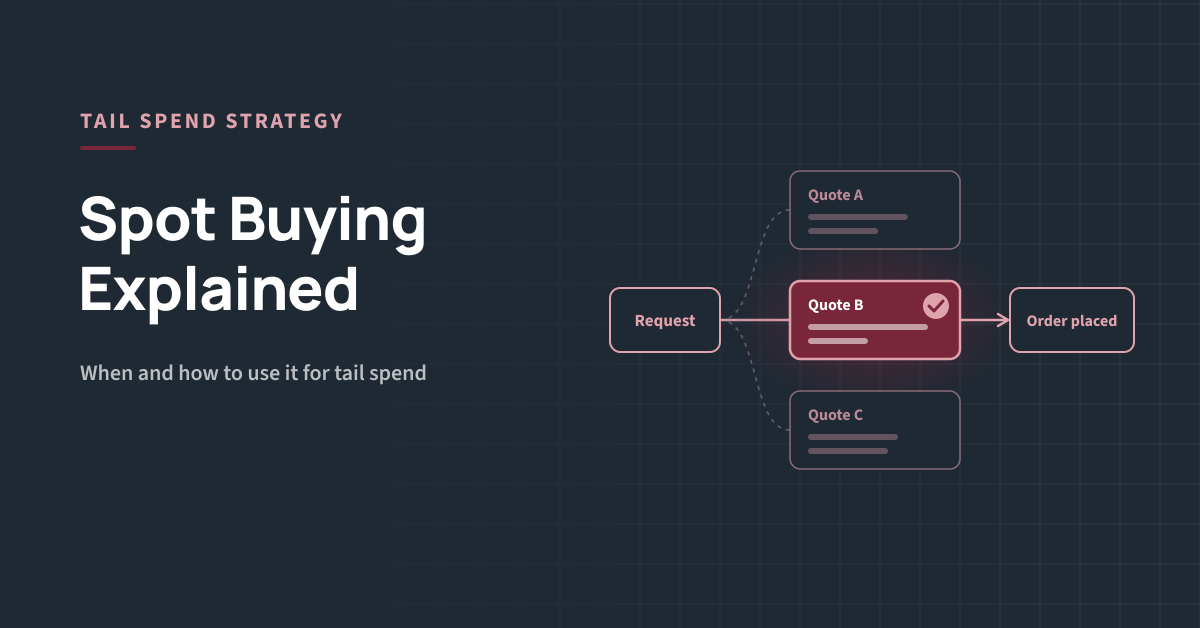
Not every purchase fits a catalogue or a contract. A venue for a one-off workshop, a specialist part for an urgent repair or a short piece of translation work all need buying, but none of them justify a full sourcing exercise. Spot buying is how most organisations handle these purchases, and how well it is done decides whether one-off buys stay fast and fair or become a source of maverick spend.
This guide explains what spot buying is, when to use it, how to run a spot buy step by step, who should run it, and how to stop repeat spot buys from quietly becoming unmanaged spend.
What Is Spot Buying?
Short answer
Spot buying is the purchase of goods or services on a one-off basis, at current market prices, without an existing contract or catalogue agreement. It is used for non-repeating, often urgent needs, and works best with a quick competitive process: get a few quotes, check the supplier, award and order.
Key Takeaways
-
- Spot buying is for genuine one-off needs that no existing contract or catalogue covers.
-
- A light, fast process with a few competing quotes keeps spot buys fair without slowing them down.
-
- Set quote and approval rules by value band, so effort matches what is at stake.
-
- Repeat spot buys are a signal: if you buy the same thing again and again, it needs a contract or catalogue.
-
- Spot buying can be run by requesters, a central desk, a managed service or automated sourcing software.
How Spot Buying Compares with Other Buying Channels
Spot buying is one of several channels in a tail spend programme. Step 4 of our
6-step tail spend strategy framework matches each type of purchase to a channel; this table shows where spot buying fits.
| Channel |
Best for |
Price set by |
Speed |
| Spot buy |
One-off goods or services with no existing agreement |
Quotes at the time of purchase |
Fast, if the process is light |
| Catalogue or punch-out |
Standard items bought repeatedly |
Pre-agreed catalogue prices |
Fastest |
| Preferred supplier or contract |
Recurring services and categories |
Negotiated contract terms |
Fast once in place |
| Strategic sourcing |
High-value or business-critical spend |
Formal tender and negotiation |
Slowest, by design |
When to Use Spot Buying
Spot buying is the right channel when a purchase is genuinely one-off and no better route exists. The table below shows common situations and when another channel works better.
| Situation |
Spot buy? |
Better route if not |
| One-off service, such as an event venue or a single translation job |
Yes |
— |
| Urgent part for a repair, not covered by any agreement |
Yes, with a fast-track process |
— |
| Specialist item bought once for a project |
Yes |
— |
| Item available in an existing catalogue |
No |
Order from the catalogue |
| Service covered by a preferred supplier |
No |
Use the preferred supplier |
| Same item or service bought several times a year |
No |
Set up a contract or catalogue |
| High-value or business-critical purchase |
No |
Strategic sourcing |
Checking for an existing option first is the most important rule. An
intake-to-procure front door can do this automatically by pointing requesters to catalogues and contracts before a spot buy starts.
How to Run a Spot Buy, Step by Step
-
- Define the need. Capture what is needed, the quantity, the deadline and any specification in a short, clear request.
-
- Check existing options. Confirm there is no catalogue item, contract or preferred supplier that already covers it.
-
- Apply the rules. Use the value band to decide how many quotes are needed and who approves.
-
- Request quotes. Invite suitable suppliers, giving each the same information and deadline.
-
- Compare offers. Look at total cost, including delivery and fees, plus lead time, terms and any supplier risk.
-
- Check the supplier. Run basic due diligence before awarding, especially for new suppliers.
-
- Award and order. Raise the purchase order, or pay by card where policy allows, and confirm with the supplier.
-
- Record and review. Keep the quotes and the reason for the choice, and flag the purchase if it is likely to repeat.
Setting Quote and Approval Rules
Matching effort to value keeps spot buying fast for small purchases and fair for larger ones. The example below shows how a policy might be structured. Set the value bands to suit your own organisation and existing thresholds.
| Value band |
Quotes required |
Approval |
| Low: below your P-card or petty purchase limit |
One, or buy direct from a reputable supplier |
Budget holder, or none within card limits |
| Medium: up to your standard approval threshold |
Two to three competing quotes |
Budget holder |
| Higher: approaching your sourcing threshold |
Three or more quotes, with procurement involved |
Budget holder plus procurement |
| Above your sourcing threshold |
Not a spot buy |
Strategic sourcing process |
Example policy structure only. Value bands and quote numbers are set by each organisation.
Write the rules down and keep them short. A one-page spot buy policy that requesters can follow is more effective than a long one that sends them looking for workarounds.
Who Should Run Spot Buys?
There are four common models, and many organisations combine them by value or category:
| Model |
How it works |
Best for |
| Requester self-service |
Requesters collect quotes and buy within clear rules and limits |
Low-value, low-risk purchases |
| Central spot-buy desk |
A small procurement team runs spot buys for the business |
Medium-value purchases needing expertise |
| Managed service |
An external team handles spot buys on your behalf |
Organisations short on internal capacity |
| Automated sourcing software |
Software finds suppliers, collects quotes and recommends or places orders within limits |
High volumes of simple, well-specified buys |
Automated spot buying, often called autonomous sourcing, is one of the most established uses of AI in tail spend. Our guide to
AI in tail spend management explains where it works and where people still need to decide. For external buying teams, see
managed services.
Risks and Controls
-
- Unchecked suppliers. Spot buys often bring in new suppliers. Run basic due diligence before the first order, not after.
-
- Split purchases. Breaking one purchase into smaller ones to stay under a threshold undermines the rules. Watch for repeated orders to the same supplier on the same day or week.
-
- Weak competition. Asking the same favourite supplier every time defeats the purpose of quotes. Rotate suppliers where you can.
-
- Poor records. Without stored quotes and reasons, you cannot show value for money or pass an audit.
-
- Hidden repeat spend. Repeat spot buys of the same item cost more over time than a negotiated agreement would.
Turning Repeat Spot Buys into Contracts
Spot buying should stay the exception. Set a simple trigger, for example when the same item or service has been spot bought three or more times in 12 months, and review whether it should move to a catalogue, a preferred supplier or a contract.
Each spot buy also carries the full process cost of a purchase. Our guide to
calculating cost per purchase order shows how to measure it, and moving repeat buys to a lower-cost channel is one of the quickest ways to reduce it.
How to Measure Spot Buying
| Measure |
What it shows |
| Cycle time from request to order |
Whether spot buys are fast enough to stop workarounds |
| Share of spot buys with competing quotes |
Whether the process is creating real competition |
| New suppliers added through spot buys |
Whether supplier growth is under control |
| Repeat spot buys moved to contracts or catalogues |
Whether recurring spend is being captured |
| Spot buys with stored quotes and reasons |
Whether records would pass an audit |
Next step
See where your organisation stands. The Tail Spend Management Assessor asks four quick questions and points you to the management approach that fits your profile, including whether software, a managed service or both would help with spot buying.
Frequently Asked Questions
What is a spot buy in procurement?
A spot buy is a one-off purchase of goods or services made at current market prices, without an existing contract or catalogue agreement. It is typically used for non-repeating or urgent needs and is a common type of tail spend.
What is the difference between spot buying and catalogue buying?
Catalogue buying uses pre-agreed items and prices from approved suppliers, so it is fast and needs no quotes. Spot buying is for needs a catalogue does not cover, and the price is set by quotes at the time of purchase.
How many quotes do you need for a spot buy?
It depends on value and your policy. Many organisations require one quote or a direct purchase for low values, two to three competing quotes for medium values, and three or more with procurement involved as the value approaches their sourcing threshold.
Can spot buying be automated?
Yes, for simple, well-specified purchases. Automated sourcing software can find suppliers, request and compare quotes, and recommend or place orders within limits you set. People still set the rules and handle complex or high-risk buys.