
What Is Autonomous Sourcing?
Short answer
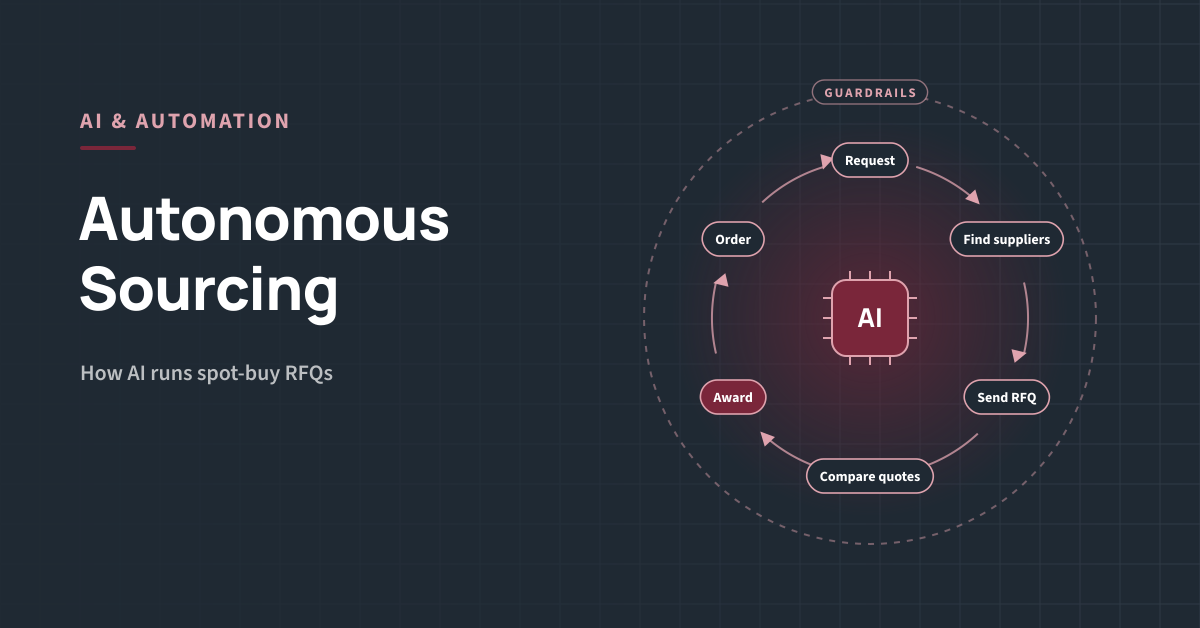
Autonomous sourcing is software that runs a simple sourcing event with little or no human input. It turns a request into a specification, finds suitable suppliers, sends requests for quotation, compares the responses and recommends or places an order within guardrails procurement sets. It works best for well-specified, low-risk spot buys.
Key Takeaways
-
- Autonomous sourcing automates the quote-gathering work that makes spot buys slow and inconsistent.
-
- It runs within guardrails: value limits, supplier pools, evaluation rules and escalation triggers.
-
- It suits simple, well-specified purchases; complex, high-risk or poorly specified needs still need people.
-
- Clean category and supplier data, a clear spot-buy policy and an intake front door make it work.
-
- Pilot in recommend mode first, then allow automatic awards for low-value purchases once results are proven.
How It Differs from Related Terms
How Autonomous Sourcing Works
-
- Receive the request. A request arrives from intake, a form or a buyer, often in plain language.
-
- Build the specification. The software turns the request into a clear specification and asks the requester for any missing detail, such as quantity, delivery date or location.
-
- Find suppliers. It selects suppliers from an approved pool, past purchases or a supplier network, applying any rules on location, certification or diversity.
-
- Send the RFQ. Every invited supplier receives the same specification and deadline.
-
- Collect and normalise quotes. Responses are converted to a like-for-like basis, including delivery, fees and payment terms.
-
- Evaluate. Offers are scored against your rules: total cost, lead time, terms and supplier risk.
-
- Award or recommend. Within guardrails, the software awards and creates the order; outside them, it sends a recommendation to a person.
-
- Record and learn. Quotes, scores and the reason for the choice are stored for audit, and results inform future supplier selection.
The Guardrails It Needs
Autonomous sourcing is only as safe as the rules around it. Set these before anything goes live:Where It Works and Where It Does Not
Where the Market Is
Autonomous sourcing is one of the more established forms of AI in procurement, and it appears as a named technology in Gartner’s 2026 Hype Cycle for Procurement and Sourcing Solutions, which describes it as optimising supplier selection and increasing competition (as quoted in a vendor press release, June 2026). The bigger constraint is readiness: Gartner’s procurement predictions report expects only 20% of procurement organisations to have enough data maturity for multiagent AI by 2027 (Gartner Predicts 2026, as summarised by Levelpath). For the wider picture, see our guide to AI in tail spend management and our tail spend management trends for 2027.Are You Ready? A Short Checklist
-
- Clean data. Categories and supplier records are classified and de-duplicated. See AI spend classification.
-
- A clear spot-buy policy. Value bands, quote rules and approvals are defined. See spot buying explained.
-
- An intake front door. Requests arrive in one place with enough detail to source. See intake-to-procure.
-
- A supplier pool. You have approved or pre-checked suppliers for the categories in scope.
-
- System connections. Awards can create purchase orders in your P2P or ERP system.
-
- An owner. Someone in procurement owns the rules, reviews escalations and checks results.
How to Pilot Autonomous Sourcing
-
- Pick one category. Choose simple, well-specified purchases with several available suppliers.
-
- Set the guardrails. Agree value limits, supplier pool, evaluation rules and escalation triggers.
-
- Start in recommend mode. Let the software run RFQs and recommend awards, with a buyer approving each one.
-
- Compare with manual buying. Measure speed, competition and prices against recent manual spot buys.
-
- Allow automatic awards. Once results hold up, let the software award below a low value limit.
-
- Expand gradually. Add categories and raise limits only as results and confidence grow.
Don’t Forget the Supplier Side
Small suppliers may be slow to respond to automated RFQs, or reluctant to quote through an unfamiliar platform. Watch response rates by category, make it easy for suppliers to reply, and keep a human route for suppliers who need one. A process that only reaches the suppliers already comfortable with the platform will gradually narrow your competition.Questions to Ask Vendors
-
- Which guardrails can we set, and can procurement change them without developer help?
-
- How do you find and vet suppliers, and can we restrict sourcing to our own approved pool?
-
- How are quotes normalised and scored, and can we see the reason for every award?
-
- What happens when too few suppliers respond or prices look unusual?
-
- How do awards connect to our P2P or ERP system?
-
- Can we start in recommend mode and switch to automatic awards later?
-
- Where is our data stored, and is it used to train models for other customers?
Next step
Find tools that fit. The Vendor Fit Finder matches your requirements to the solution types worth evaluating, and our guide to tail spend software explains what platforms typically cover.