
What Is No-PO-No-Pay?
Short answer
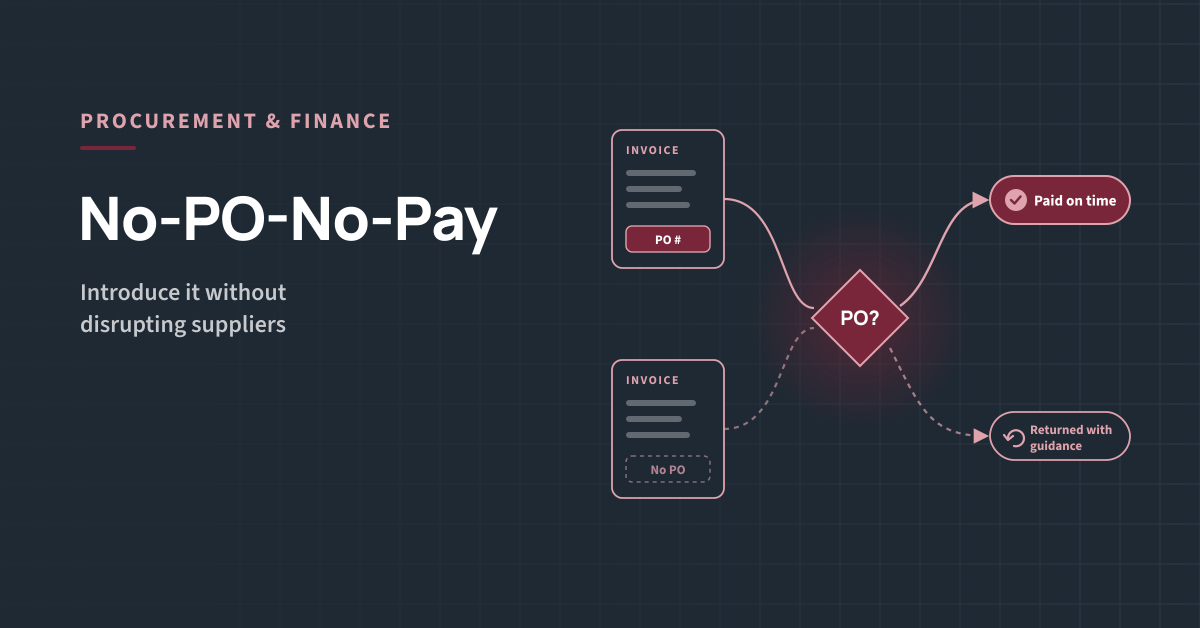
No-PO-no-pay is a policy that requires every supplier invoice to quote a valid purchase order before it is paid, apart from a short list of agreed exceptions. It makes sure purchases are approved before they happen rather than after, which brings tail spend into the agreed process and gives finance accurate commitments.
Key Takeaways
-
- No-PO-no-pay moves approval to before the purchase, which is where control over tail spend starts.
-
- Fix the buying side first: if raising a PO is slow, people will raise it after the invoice arrives.
-
- Agree a short, written list of exceptions, such as utilities, card payments and statutory charges.
-
- Phase the rollout with a warning period, and tell suppliers clearly and early.
-
- Do not penalise suppliers for internal failures. Resolve returned invoices quickly and pay on time once a PO exists.
Why It Matters for Tail Spend
Tail purchases are where invoices most often arrive without a purchase order. Someone agrees a job by phone or email, the supplier delivers and invoices, and accounts payable then chases an approver to confirm it. By then the supplier, price and terms have already been chosen without procurement. Our guide to the real cost of tail spend explains the price leakage and risk this creates. No-PO-no-pay reverses the order. It also improves one of the four core measures in our guide to tail spend KPIs: PO compliance.Fix the Buying Side First
The most common reason no-PO-no-pay fails is that raising a purchase order is too slow or too hard. Before you enforce the policy, make the compliant route easy:-
- One front door for requests. An intake-to-procure process makes it simple to request a purchase and get a PO.
-
- Catalogues for common items. Pre-approved items can create POs in a few clicks.
-
- Cards for small purchases. Low-value, low-risk buys can go on a card instead of a PO. See our guide to P-card policy.
-
- Blanket POs for recurring services. A single PO covering a period or value allows repeat invoices without a new PO each time.
-
- Fast approvals. Set approval thresholds so small purchases are approved quickly.
What Changes for Whom
Agree Your Exceptions
Some payments do not fit the PO process. List them in writing, keep the list short, and review it each year.How to Roll It Out in Four Phases
Step-by-Step Checklist
-
- Measure the baseline. Find the share of tail invoices that arrive without a PO, and the suppliers and categories behind them.
-
- Fix the routes to a PO. Intake, catalogues, cards, blanket POs and faster approvals.
-
- Write the policy and exceptions. Keep it short and get finance leadership to sign it off.
-
- Brief internal teams. Explain what changes for requesters, budget holders and AP, and why.
-
- Notify suppliers. Send clear notice with the go-live date and how to quote a PO.
-
- Run the warning period. Pay non-PO invoices but flag and follow up every one.
-
- Go live. Return or hold non-PO invoices with clear instructions on what to do next.
-
- Resolve fast. Get POs raised quickly for genuine purchases so suppliers are not left waiting.
-
- Monitor and adjust. Track the measures below and refine the rules.
What to Tell Suppliers
Clear communication prevents most supplier problems. Adapt this notice to your organisation:Sample supplier notice
Subject: Purchase order numbers required on all invoices from [date]
From [date], every invoice sent to [organisation] must quote a valid purchase order (PO) number. This helps us approve purchases in advance and pay you on time.
What you need to do: before supplying any goods or services, ask your contact at [organisation] for a PO number. Quote it in the [reference field / top right] of your invoice and send invoices to [AP email address].
Invoices without a PO: from [date], invoices that do not quote a valid PO will be returned to you with guidance on how to obtain one. Until then, we will continue to pay them but will contact you to confirm the PO.
Questions: contact [name, email, phone]. Thank you for your support.
Protecting Suppliers
-
- Do not punish suppliers for internal failures. If an employee ordered without a PO, help the supplier get one quickly.
-
- Pay promptly once a PO exists. Returned invoices should not lose their place in the payment run once corrected.
-
- Give small suppliers extra help. They are most affected by delays and least likely to have read your notice.
-
- Check payment obligations. Late-payment rules in many countries give suppliers rights to interest on overdue invoices. Confirm with your finance or legal team how returned invoices are treated.
How to Measure Success
Common Mistakes
-
- Switching it on before fixing the buying side. The result is a wave of retrospective POs.
-
- No warning period. Suppliers and employees learn about the policy from returned invoices.
-
- Too many exceptions. A long exception list becomes the new normal route.
-
- AP left alone to enforce it. Without visible support from finance leadership, AP faces pressure to make exceptions.
-
- Measuring compliance only. High compliance with many retrospective POs means control has not really moved upstream.
Next step
See where your organisation stands. The Tail Spend Management Assessor asks four quick questions and points you to the management approach that fits your profile, so you can see which changes to make before switching on no-PO-no-pay.