
What Is Intake-to-Procure?
Short answer
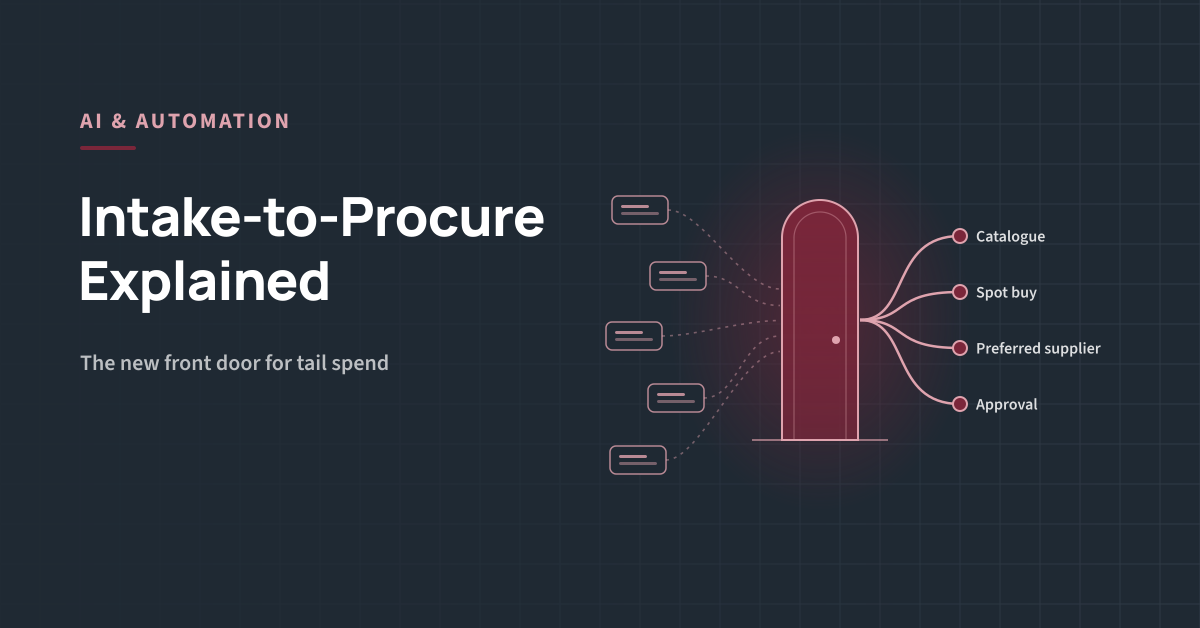
Intake-to-procure is a single front door for purchase requests. An employee describes what they need, and the system classifies the request, applies policy and risk checks, routes it to the right buying channel and approver, and creates the order in your procurement system, giving everyone visibility from request to purchase.
Key Takeaways
-
- Most tail spend leakage starts with a request that never reaches the right channel.
-
- Intake-to-procure gives every request one starting point and routes it automatically.
-
- It sits in front of your existing procurement and finance systems rather than replacing them.
-
- AI makes intake easier by understanding plain-language requests and suggesting existing contracts or suppliers.
-
- Success is measured by how much tail spend enters through intake and how quickly requests are fulfilled.
Why Tail Requests Need a Front Door
Procurement processes are usually designed around the buyer, not the requester. Employees face a choice of forms, systems and policies they rarely use and often do not understand. Faced with that, many skip the process altogether.-
- Too many entry points. Requests arrive by email, chat, forms, tickets and phone, so no one sees the full picture.
-
- Requesters do not know the rules. They cannot tell whether something needs a quote, a security review or simply a catalogue order.
-
- Slow responses drive workarounds. When a small request takes days, people buy on a card or on expenses instead.
-
- Late involvement. Procurement often hears about a purchase after the supplier has been chosen or the invoice has arrived.
How Intake-to-Procure Works
Most intake-to-procure processes follow six steps:-
- Request. The employee describes what they need, in a short guided form or in plain language.
-
- Classify. The system works out the category, likely value and request type, such as goods, services, software or a renewal.
-
- Check. Policy and risk rules decide what else is needed, for example a security review for software or due diligence for a new supplier.
-
- Route. The request goes to the right channel: a catalogue, a preferred supplier, a spot-buy process, a contract owner or a buyer.
-
- Approve. Approvals follow value and risk thresholds, so small, low-risk requests move quickly.
-
- Order and track. The purchase order is created in your procurement or ERP system, and the requester can see progress at every stage.
Intake vs Orchestration vs Procure-to-Pay
These terms overlap and vendors use them differently. This is how they usually fit together:Where AI Fits
Early intake tools were structured forms with routing rules. AI has made them easier to use and smarter at triage:-
- Plain-language requests. Employees describe what they need in their own words, and the system extracts category, quantity and urgency.
-
- Smarter classification. Requests are matched to the right category and policy even when descriptions are vague.
-
- Reuse before buying. The system can suggest an existing contract, catalogue item or approved supplier before a new purchase is started.
-
- Duplicate detection. Repeat or overlapping requests, such as a second licence for a tool already in use, can be flagged.
-
- Pre-filled details. Supplier and budget information can be filled in automatically, cutting back-and-forth.
Benefits for Tail Spend
-
- More spend under management. Requests that used to bypass procurement now enter through one door.
-
- Faster buying. Simple requests go straight to the right channel, without waiting for a buyer to triage them.
-
- Fewer new suppliers. Pointing requesters to existing contracts and preferred suppliers slows supplier growth.
-
- Earlier risk checks. Security, legal and due diligence reviews start before a supplier is chosen, not after.
-
- Better data for finance. Every request is captured with a category, value and owner, which feeds budgeting and the business case for controlling tail spend costs.
Where the Market Is Heading
Intake has moved from a niche add-on to a mainstream part of procurement technology. Gartner now runs a dedicated Peer Insights market for procurement orchestration platforms (Gartner Peer Insights). In its 2026 Magic Quadrant for Source-to-Pay Suites, Gartner included a provider built on intake and orchestration for the first time (Pure Procurement analysis, 2026). Industry analysis also describes intake vendors expanding into sourcing and payables while major suites rebuild their own front doors (Pure Procurement, 2026). For buyers, that means intake is available both as a standalone layer and inside larger suites. Our tail spend management trends for 2027 cover this convergence in more detail.How to Get Started
-
- Map today’s entry points. List every way requests currently arrive and roughly how many come through each.
-
- Pick your top request types. Start with the highest-volume tail requests, such as IT accessories, software, events and small services.
-
- Write the routing rules. For each request type, decide the channel, the checks and the approvers.
-
- Connect to existing systems. Make sure approved requests create orders in the P2P or ERP system finance already uses.
-
- Pilot with one group. Launch with one department or region, gather feedback and adjust the rules.
-
- Measure and expand. Track results, then add request types and teams.
Questions to Ask Intake Vendors
-
- How does the tool handle plain-language requests, and what happens when it is unsure?
-
- Can procurement change routing rules without developer help?
-
- Which P2P, ERP and contract systems does it connect to, and how?
-
- How are risk reviews, such as IT security and legal, triggered and tracked?
-
- Can it suggest existing contracts and catalogue items before a new purchase?
-
- What reporting does it give on volume, cycle time and spend entering through intake?
Next step
Find tools that fit your stack. The Vendor Fit Finder matches your requirements to the solution types worth evaluating, and our guide to tail spend software explains what platforms typically cover.