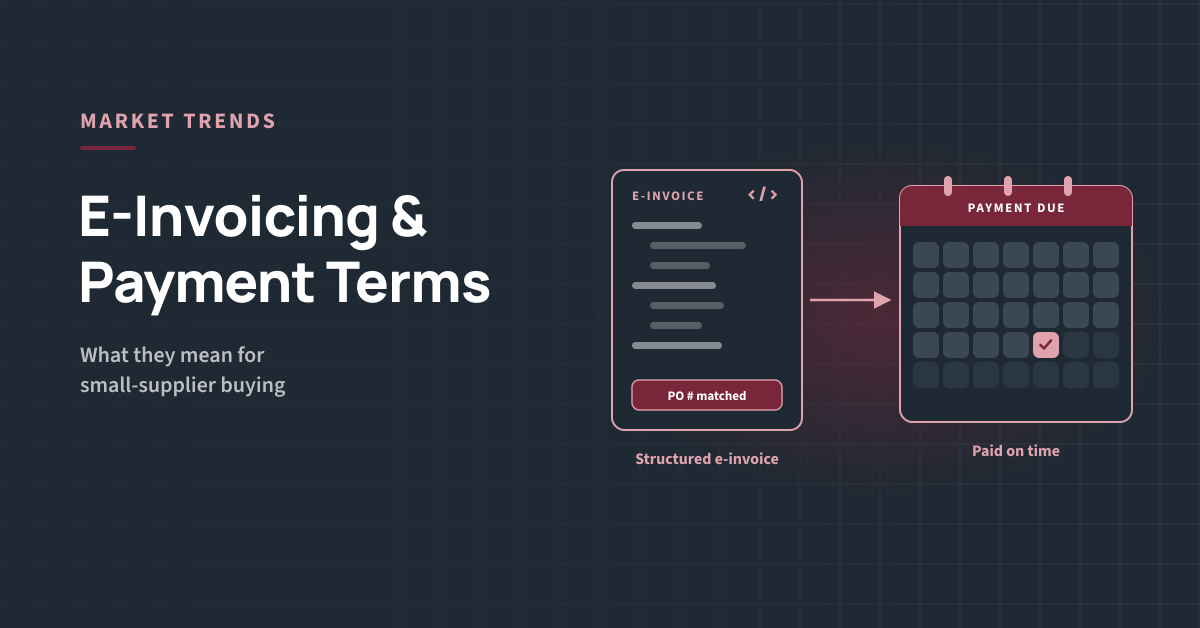
Two sets of rules are changing how organisations pay their smallest suppliers. E-invoicing mandates are replacing PDFs and paper with structured electronic invoices, country by country. At the same time, governments are tightening the rules on how long businesses can take to pay. Both land hardest on tail spend, where suppliers are small, numerous and least able to absorb change or delay.
This guide summarises where e-invoicing mandates and payment-terms rules stand as of October 2026, separates what is law from what is still proposed, and sets out what buyers should do now.
What Do These Rules Mean for Small-Supplier Buying?
Short answer
E-invoicing mandates mean buyers must be able to receive structured e-invoices, and small suppliers must be able to send them, in a growing list of countries. Payment-terms rules cap how long larger buyers can take to pay smaller suppliers, with interest due on late payment. Together, they push buyers to process tail invoices faster, cleaner and on time.
Key Takeaways
-
- E-invoicing is mandatory or phasing in across Belgium, Poland and France, with Germany, Slovakia and Polish micro-businesses following from January 2027.
-
- Small suppliers in your tail may need help to send compliant e-invoices, especially in the first year of each mandate.
-
- In the EU, the proposed 30-day payment cap has stalled, so the 2011 Late Payment Directive still sets the rules.
-
- In the UK, the Commercial Payments Bill proposes a 60-day maximum for commercial contracts, but it was still before Parliament as of October 2026.
-
- Faster, cleaner invoice processing is the common answer to both sets of rules.
Why These Rules Matter for Tail Spend
Tail spend is where most of your small suppliers sit. They send many low-value invoices, often in inconsistent formats, and they feel late payment most. That makes the tail the part of your supplier base most affected by both e-invoicing mandates and payment-terms rules, and the part where non-compliance is most likely to go unnoticed. Our guide to
what tail spend is explains why the tail is so fragmented.
Part 1: E-Invoicing Mandates
E-invoicing mandates require invoices between businesses to be sent as structured data in an approved format, often through a national platform or a network such as Peppol, rather than as PDFs or paper. Some countries also require the tax authority to clear each invoice before it reaches the buyer.
| Country or rule |
What applies now |
Next key date |
| Belgium |
Structured B2B e-invoicing via Peppol, live since 1 January 2026 |
E-reporting planned for 2028 |
| Poland (KSeF) |
Mandatory for large taxpayers since February 2026 and most businesses since April 2026 |
Micro-businesses join 1 January 2027; penalties proposed to start 1 January 2028 |
| France |
All businesses must receive e-invoices; large and mid-sized firms must issue them, since 1 September 2026 |
Small and micro firms must issue from 1 September 2027 |
| Germany |
All businesses must be able to receive e-invoices since January 2025 |
Mandatory issuing phases in from 1 January 2027, all B2B from 2028 |
| Slovakia |
Not yet mandatory |
B2B e-invoicing from 1 January 2027 |
| EU (ViDA) |
Not yet in force |
EU-wide digital reporting for cross-border trade from 1 July 2030 |
Sources: WiseTREND (September 2026), Opulon (2026), Layerz (September 2026), VATupdate (September 2026). Dates can change; check official guidance.
Sources for the table:
WiseTREND,
Opulon,
Layerz and
VATupdate. Poland’s proposed penalty delay was still a draft as of the end of September 2026 and does not delay the obligation to use KSeF.
What it means for buyers
-
- Your AP process must receive e-invoices in every mandate country where you buy, in the formats and networks each one uses.
-
- Small suppliers may struggle at first. Expect some to send invoices in the wrong format or through the wrong channel, and plan how to support them.
-
- Purchase order numbers matter more. Structured invoices can be matched to POs automatically, but only if suppliers quote a valid PO.
-
- Fewer manual steps. Once working, e-invoicing reduces keying, errors and processing time for tail invoices.
Part 2: Payment-Terms Rules
Payment-terms rules set the maximum time a buyer can take to pay and what happens if it pays late. Here the picture differs sharply between the EU and the UK.
| Jurisdiction |
Current rule |
What is changing |
Status (October 2026) |
| EU |
Late Payment Directive (2011): B2B payment within 30 days by default, up to 60 days by agreement, and longer only if not grossly unfair; statutory interest and a fixed compensation amount for late payment |
A 2023 proposal for a strict 30-day cap |
Stalled; widely reported as effectively dead after member states opposed it |
| UK |
Late Payment of Commercial Debts Act: statutory interest at 8% above Bank of England base rate where contracts are silent |
Commercial Payments Bill: 60-day maximum for commercial contracts (30 days for public authorities), mandatory late payment interest, stronger Small Business Commissioner powers |
Introduced May 2026 and still before Parliament; cap expected no earlier than 2027 |
On the EU, the Commission’s 2023 proposal was blocked by member states, and the existing directive remains in force (
LatePayClaim, 2026;
Embat, 2026). Under the directive, late payment interest is set at the ECB reference rate plus 8 percentage points, with fixed compensation of EUR 40 per late invoice (
Invoxo).
In the UK, the government describes the Commercial Payments Bill as the most significant late payments legislation in over 25 years (
GOV.UK). Under the Bill, payment terms longer than the cap would be void, and the Small Business Commissioner could fine persistent late payers up to 1% of annual UK turnover (
Macfarlanes, 2026). Key definitions, such as which businesses count as large, are left to secondary legislation (
Baker McKenzie, May 2026).
What it means for buyers
-
- Review your standard payment terms with small suppliers, especially any longer than 60 days.
-
- Check how invoice disputes and returns work. Holding or returning an invoice can still leave you liable for late payment interest if the purchase was genuine.
-
- Track payment performance for small suppliers, not just averages across all suppliers.
-
- Watch the UK Bill as it passes through Parliament, and plan contract changes before the cap takes effect.
How the Two Connect
Payment-terms rules ask you to pay small suppliers on time; e-invoicing gives you the means. Structured invoices that quote a valid PO can be matched and approved automatically, which removes most of the delay in paying small, low-value invoices. Policies that hold invoices, such as
no-PO-no-pay, need to resolve returned invoices quickly so they do not turn into late payments.
What to Do Now
-
- Map your exposure. List tail suppliers by country and identify those in current or upcoming e-invoicing mandates.
-
- Check AP readiness. Confirm your systems or service providers can receive e-invoices in every relevant format and network.
-
- Contact small suppliers early. Explain what you need, share PO and invoicing guidance, and point them to low-cost compliant tools.
-
- Review payment terms. Identify contracts with small suppliers that exceed 60 days and plan changes.
-
- Speed up approvals. Use PO matching, intake and cards to cut the time between invoice and payment.
-
- Measure on-time payment. Track it for small suppliers specifically, and act on persistent delays.
For the wider picture, see our
Q3 2026 recap and
tail spend management trends for 2027.
Next step
Find providers that can help. The Vendor Almanac lists sourced profiles of tail spend providers, and the Vendor Fit Finder matches your requirements to the solution types worth evaluating.
Frequently Asked Questions
What is an e-invoicing mandate?
An e-invoicing mandate is a legal requirement for businesses to send and receive invoices as structured electronic data in an approved format, often through a national platform or a network such as Peppol, instead of PDFs or paper.
Has the EU introduced a 30-day payment cap?
No. The European Commission proposed a strict 30-day cap in 2023, but the proposal stalled after member states opposed it. The 2011 Late Payment Directive still applies, with a 30-day default and up to 60 days by agreement for business-to-business payments.
What is the UK Commercial Payments Bill?
It is UK legislation introduced in May 2026 that proposes a 60-day maximum payment term for commercial contracts, 30 days where the buyer is a public authority, mandatory interest on late payments and stronger enforcement powers for the Small Business Commissioner. It was still before Parliament as of October 2026.
How should buyers support small suppliers with e-invoicing?
Give clear notice of what you need, explain how to quote PO numbers, point suppliers to low-cost compliant invoicing tools or your supplier portal, and allow a short transition period while you resolve format issues quickly.
Sources
Last reviewed: October 2026. This article summarises public information and is not legal or tax advice. Check official guidance and take professional advice for your situation.