
Which Tail Spend Model Is Right for You?
Short answer
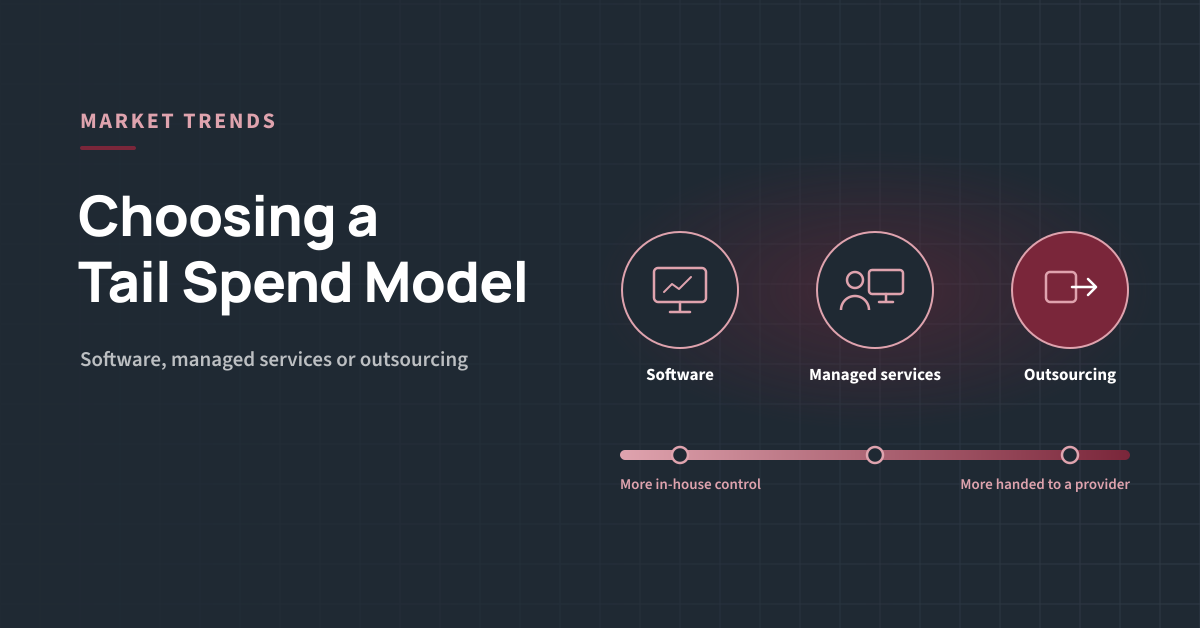
Choose software if your main problem is visibility and process and you have a team to run it. Choose managed services if you lack capacity but want to keep control. Choose outsourcing if you want to transfer defined, repeatable buying to a partner. Many organisations combine models, split by type of purchase.
Key Takeaways
-
- The biggest deciding factor is your constraint: technology and process, or people and capacity.
-
- Software keeps execution and data in-house; outsourcing transfers execution; managed services sit in between.
-
- Vendor consolidation is a strategy, not an operating model, and works alongside any of the three.
-
- Hybrid models that combine software with external buying teams are increasingly common.
-
- You do not have to choose one model for all tail spend. Match the model to each segment.
The Three Models in Brief
Tail spend software
A platform your own team operates, typically combining spend analytics, guided buying, spot sourcing and workflow. Your team configures the rules, reviews exceptions and runs the process day to day. See our guide to tail spend software.Managed services
A provider’s buying team works inside your process, handling requests and sourcing on your behalf, while you keep ownership of policy and decisions. It adds capacity without handing over control. See managed services.Outsourcing
A partner takes over defined buying activity end to end, often a whole category or all spend below a threshold, under a contract with agreed service levels. See procurement outsourcing.Side-by-Side Comparison
Where Vendor Consolidation Fits
Vendor consolidation reduces the number of suppliers behind recurring categories, by moving spend to fewer, preferred suppliers or catalogues. It is a strategy rather than an operating model, so it can run alongside software, managed services or outsourcing. Whichever model you choose, consolidating recurring spend usually delivers some of the quickest results.How to Choose: Six Questions
-
- What is your main constraint? If it is visibility, data and process, software is the natural starting point. If it is people and time, look at managed services or outsourcing.
-
- How much control must stay in-house? Regulated organisations, or those with sensitive categories, often prefer software or managed services.
-
- Who would own a platform? Software only works with a named owner and time to configure and run it.
-
- How varied is your tail? A tail full of specialist services may need expert buyers; a tail of standard goods suits catalogues and automation.
-
- What systems do you have? Check how each option connects to your ERP, P2P and card programmes.
-
- How quickly do you need results? Weigh implementation and transition time against the urgency of the business case.
The Trend: Hybrid Models
The choice is becoming less either-or. Technavio’s 2026 market report on tail spend management solutions identifies a shift towards managed services and hybrid models (Technavio, March 2026), and Mordor Intelligence describes technology-plus-expertise bundles emerging that combine platform speed with managed analytics (Mordor Intelligence). An industry review of tail spend providers in 2026 also notes demand for managed services rising alongside automation rather than being replaced by it, because many teams lack the bandwidth to run any tail process at all (APSentra, 2026). In practice, that means many providers now offer software with an optional buying team, and many service providers bring their own technology. Our tail spend management trends for 2027 cover this shift alongside AI and intake.Splitting Models by Segment
You do not need one model for all tail spend. Segment your tail, as described in Step 3 of our 6-step tail spend strategy framework, and match each segment to the model that suits it.Questions to Ask Providers
-
- Which parts of the process do you run, and which stay with us?
-
- How are decisions, policy and exceptions governed?
-
- Whose systems hold our data, and can we access and export it at any time?
-
- How is the fee structured, and what happens if volumes change?
-
- What service levels do you commit to, and how are they reported?
-
- How do you handle specialist categories and urgent requests?
-
- What does exit look like if we change model later?
Next step
Find the model that fits. The Tail Spend Management Assessor points you to the approach that matches your profile, and the Vendor Almanac lists sourced profiles of software, managed service and outsourcing providers.