
What Changed in Tail Spend Management in Q3 2026?
Short answer
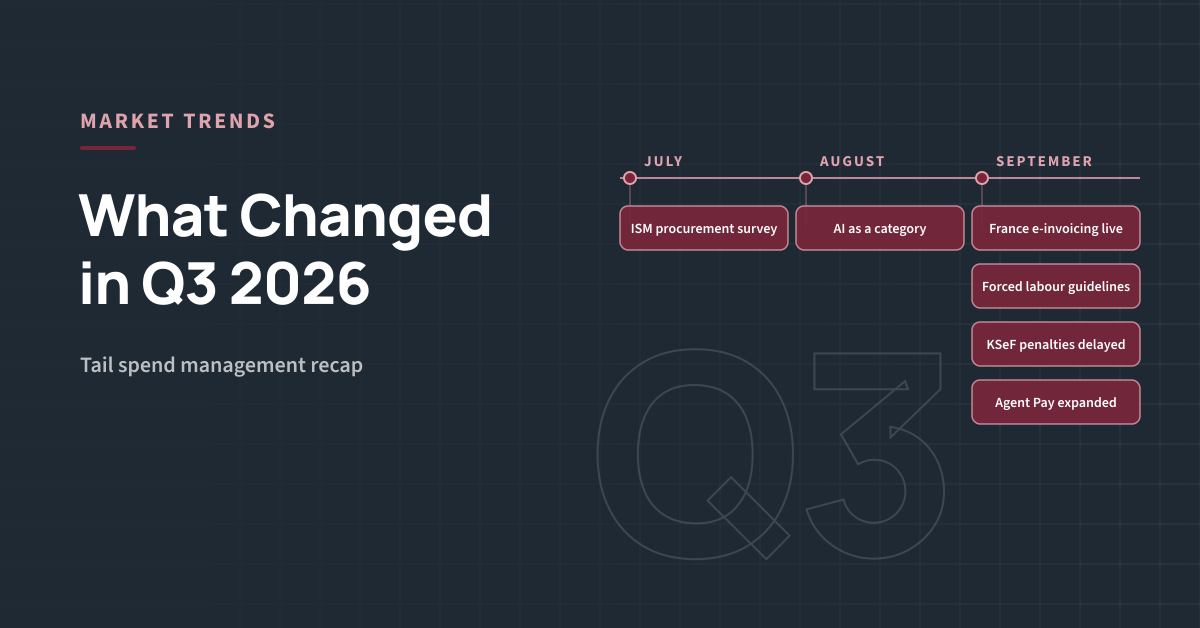
In Q3 2026, France’s e-invoicing mandate went live, Poland proposed delaying KSeF penalties to 2028 without delaying the mandate, the EU finalised its Forced Labour Regulation guidelines, Gartner urged procurement leaders to manage AI as its own category, and payment networks expanded services for AI-initiated purchases.
Key Takeaways
-
- E-invoicing moved from plan to reality in France, and suppliers of every size there must now be able to receive e-invoices.
-
- Poland’s proposed penalty delay buys time, but the obligation to use KSeF stays in force.
-
- Final EU guidance on forced labour gives buyers a clearer view of what due diligence should look like before the December 2027 ban.
-
- Gartner now frames AI as something procurement must govern as a category, not just a feature inside tools.
-
- Survey data shows strategy is ahead of execution: most organisations still rely on manual reporting.
Q3 2026 at a Glance
1. Procurement Is Asked to Govern AI as a Category
In August, Gartner advised chief procurement officers to manage AI capabilities, not just AI suppliers, as AI becomes embedded in software, services and autonomous agents. It positioned procurement as the function that brings visibility, governance and commercial discipline across IT, legal, security, risk and the business (Gartner, 18 August 2026). What it means for tail spend. A lot of AI arrives through the tail: low-cost subscriptions, add-on features and tools bought on cards. If procurement is to govern AI, it needs to see those purchases. A single front door for requests, as described in our guide to intake-to-procure, is a practical place to start.2. Payment Networks Build for AI-Initiated Purchases
On 30 September, Mastercard expanded Agent Pay, its programme for agent-led payments, with new trust and intelligence services that give more context on transactions started by AI (Mastercard, 30 September 2026). The announcement focuses on consumer commerce, but the same rails are relevant to business buying. Payments coverage in September also reported banks embedding virtual cards into enterprise procurement platforms, with card networks building infrastructure for agent-initiated commerce (PYMNTS, 2026). What it means for tail spend. If AI agents start buying low-value items, controlled payment methods such as single-use virtual cards with limits become the natural way to pay. Review your card policy now, as our 2027 trends outlook recommends.3. Strategy Is Ahead of Execution
In July, research from the Institute for Supply Management and Amazon Business found that 71% of organisations say balancing cost and risk now drives procurement strategy, but only 45% feel prepared for supply chain disruption and 65% still rely on manual reporting for supply chain data. Most use e-procurement platforms (58%) and supplier portals (51%) (ISM and Amazon Business, 14 July 2026; vendor co-sponsored research). Marketplace buying also drew scrutiny. A 2026 investigation of public-sector purchasing by the Institute for Local Self-Reliance argued that dynamic marketplace pricing raised costs for some governments and reduced competitive bidding (ILSR, 2026). What it means for tail spend. Tools are widely in place, but data and execution lag. Before adding new technology, check whether your current tools capture tail spend cleanly. Where marketplaces carry tail buying, benchmark prices on a sample of repeat items each quarter.4. France’s E-Invoicing Mandate Goes Live
From 1 September 2026, all VAT-registered businesses established in France must be able to receive structured e-invoices, and large and mid-sized companies must issue them. Small and micro businesses follow with issuing from 1 September 2027 (Layerz, September 2026; WiseTREND, September 2026). What it means for tail spend. If you buy from or operate in France, your AP process must accept e-invoices from French suppliers, including the smallest ones from next year. Check that your systems and service providers are ready, and expect some small suppliers to need help switching.5. Poland Delays KSeF Penalties, Not the Mandate
On 16 September, Poland’s Ministry of Finance announced it would extend the penalty-free period for KSeF errors to the end of 2027, and a draft bill published on 22 September would apply the penalties from 1 January 2028 (Thomson Reuters, September 2026). The change is still a proposal, with adoption planned for the fourth quarter, and it does not delay mandatory use of KSeF. Micro-businesses still join on 1 January 2027 (VATupdate, 29 September 2026). What it means for tail spend. Treat the delay as breathing room, not a reprieve. Small Polish suppliers in your tail must still use KSeF from January, and invoices issued outside the system remain non-compliant.6. EU Forced Labour Guidelines Are Finalised
The European Commission published its guidelines on the Forced Labour Regulation at the end of June, and the final version appeared in the EU’s Official Journal on 3 September 2026 without changes. The Commission also began information sessions in September, including one for SMEs, while its forced labour risk database was still being developed (Linklaters, updated September 2026). The guidelines confirm the regulation does not impose a formal due diligence duty, but effective due diligence can be important evidence in an investigation (Baker McKenzie, August 2026). What it means for tail spend. The ban applies to all businesses from 14 December 2027, whatever their size. Add basic forced labour screening to onboarding for product suppliers in your tail, prioritising higher-risk categories and regions.What to Do in Q4 2026
-
- Find the AI in your tail. List AI tools and subscriptions bought outside procurement, and route new requests through intake.
-
- Check e-invoicing readiness. Confirm your AP systems can receive e-invoices in France now and in Germany and Poland from January.
-
- Talk to small suppliers. Identify tail suppliers in mandate countries that may need support to switch.
-
- Update onboarding. Add forced labour screening for product suppliers, starting with higher-risk categories.
-
- Review card and marketplace controls. Set limits for any automated or agent-led purchasing, and benchmark marketplace prices.
-
- Clean your data. Manual reporting limits every one of these steps.
Dates to Watch
Sources: VATupdate, Linklaters, Opulon and Layerz (2026). Dates can change; check official guidance.
Next step
See the bigger picture. Read our tail spend management trends for 2027, then use the Vendor Almanac to compare providers that can help with intake, payments and supplier compliance.