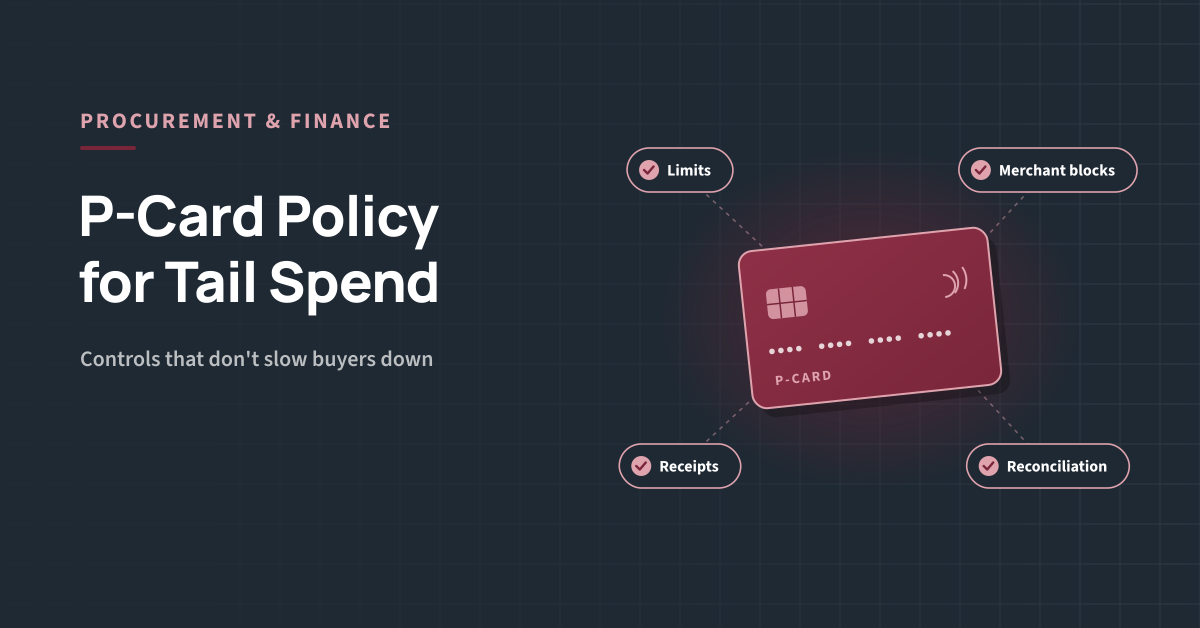
Purchasing cards are one of the simplest ways to handle tail spend. A small, low-risk purchase that would otherwise need a requisition, approval, purchase order, invoice and payment run can be paid in seconds. The catch is control. Without a clear policy, cards become a way around procurement rather than a channel within it.
This guide explains when P-cards suit tail spend, which card types to use, the controls that work without slowing buyers down, and what a practical P-card policy should include.
What Is a P-Card Policy?
Short answer
A P-card policy sets the rules for using purchasing cards: who can hold one, what they can buy, spending limits, blocked merchant categories, receipt and coding requirements, and how transactions are reviewed and reconciled. For tail spend, a good policy lets low-value, low-risk purchases skip the purchase order process while keeping the spend visible and compliant.
Key Takeaways
-
- P-cards cut the process cost of small purchases by removing the PO and invoice steps.
-
- Use cards for low-value, low-risk tail purchases, and keep catalogues and contracts first where they exist.
-
- Controls built into the card, such as limits and merchant blocks, work better than rules people have to remember.
-
- Virtual cards add control for one-off purchases, subscriptions and specific suppliers.
-
- Reconcile monthly and watch for split transactions, or card spend becomes invisible spend.
Why P-Cards Suit Tail Spend
Every purchase order triggers the same chain of work, whatever its value. For a small purchase, the cost of that process can be a large share of what was bought, as our guide to
calculating cost per purchase order shows. A card removes most of those steps: no PO, no supplier invoice to match, and one consolidated statement instead of many payments.
Business card use is growing quickly. Juniper Research forecasts that B2B card payments will rise from $5.9 trillion in 2026 to $10.9 trillion in 2030, citing better controls and visibility as drivers (
Juniper Research, March 2026). Those same controls are what make cards safe for tail spend.
When to Use a P-Card
| Purchase |
Use a P-card? |
Better route if not |
| Low-value, low-risk goods from a reputable supplier |
Yes |
— |
| Urgent small purchase, such as a part for a repair |
Yes, within limits |
— |
| Low-cost online subscription or registration fee |
Yes, ideally a virtual card |
— |
| Item available in an existing catalogue |
No |
Order from the catalogue |
| Service from a supplier who will work on site |
Usually not |
PO with supplier checks |
| Purchase involving personal or sensitive data |
No |
Route through intake for a risk review |
| Anything above the card limit |
No |
Spot buy or sourcing process |
The “catalogue first” rule matters. If cards are used to buy items already covered by an agreed catalogue or contract, they undermine the prices you negotiated. Step 4 of our
6-step tail spend strategy framework explains how to match each type of purchase to a channel.
Choosing the Right Card Types
| Card type |
How it works |
Best for |
| Physical P-card |
A card issued to an employee for business purchases within set limits |
Frequent small purchases by named cardholders |
| Single-use virtual card |
A card number created for one purchase, with an exact amount and expiry |
One-off online purchases and spot buys |
| Supplier-specific virtual card |
A virtual card that only works with one supplier |
Recurring subscriptions and regular suppliers |
| Department or lodge card |
A card held centrally and charged by approved suppliers |
Shared services such as travel or couriers |
Many organisations now issue virtual cards through their spend management or procurement platform, so a card is created only after a request is approved. That links card spend to a request, an approver and a category from the start.
Controls That Work Without Slowing Buyers Down
The best controls are built into the card and the systems around it, so cardholders do not need to remember rules at the point of purchase.
| Control |
What it does |
How to keep it fast |
| Transaction limit |
Caps the value of any single purchase |
Set by role and need, not one limit for everyone |
| Monthly limit |
Caps total spend per card per month |
Allow quick, approved temporary increases |
| Merchant category blocks |
Declines purchases at blocked merchant types, such as cash or gambling |
Block what is clearly out of scope; review declines monthly |
| Preferred supplier nudges |
Points cardholders to agreed suppliers and catalogues |
Show the preferred option inside the buying flow |
| Receipt capture |
Requires a receipt or invoice for every transaction |
Let cardholders photograph receipts on a phone |
| Automatic coding |
Assigns category and cost centre to each transaction |
Pre-fill from merchant and history; cardholder confirms |
| Split-transaction checks |
Flags purchases broken up to stay under a limit |
Run automatically; follow up only on flagged cases |
| Monthly reconciliation |
Cardholder and approver confirm every transaction |
Set a fixed deadline and send reminders |
What Your P-Card Policy Should Include
Keep the policy short enough to read in one sitting. Cover these points:
-
- Purpose and scope. What cards are for, and how they fit alongside catalogues, contracts and purchase orders.
-
- Eligibility. Who can hold a card, how to request one, and the cardholder agreement they sign.
-
- Allowed and prohibited purchases. Clear examples of both, including the catalogue-first rule.
-
- Limits. Transaction and monthly limits by role, and how to request a change.
-
- Receipts and coding. What evidence is needed and how transactions are coded.
-
- Reconciliation. Monthly deadlines for cardholders and approvers.
-
- Misuse. What counts as misuse, how it is handled, and the consequences.
-
- Lost or stolen cards. Who to contact and how quickly.
-
- Leavers and role changes. When cards are cancelled or limits changed.
-
- Review. Who owns the policy and how often it is reviewed.
Common P-Card Failures and How to Avoid Them
-
- Limits set too low. Cardholders hit limits and switch to expenses or personal cards. Set limits from real purchase patterns.
-
- Limits set too high. Cards start replacing sourcing for larger purchases. Keep limits below your spot buy or sourcing thresholds.
-
- Cards bypassing contracts. Buyers pay a non-preferred supplier for items you already have agreed prices on. Nudge or block where possible.
-
- Split purchases. One purchase is broken into several to stay under the limit. Flag and follow up automatically.
-
- Late reconciliation. Transactions sit uncoded for months, and spend disappears from reports. Enforce monthly deadlines.
-
- Too many cards. Every extra cardholder adds risk and admin. Issue cards on clear need, and review unused cards regularly.
Who Does What
P-card programmes work best when ownership is shared. Finance usually owns the card programme, limits and reconciliation. Procurement owns the catalogue-first rule, preferred suppliers and which categories belong on cards. Budget holders approve monthly statements, and cardholders capture receipts and code transactions. Our guide to
the real cost of tail spend includes a shared RACI for procurement, finance and accounts payable.
How to Measure Your P-Card Programme
| Measure |
What it shows |
| Share of eligible tail transactions paid by card |
Whether cards are replacing low-value POs as intended |
| Transactions reconciled on time |
Whether card spend stays visible and coded |
| Card spend with preferred suppliers |
Whether cards support or bypass agreed prices |
| Split transactions flagged |
Whether limits are being worked around |
| Declined transactions by reason |
Whether limits and blocks are set at the right level |
| Active cards versus cards issued |
Whether the number of cards matches real need |
Next step
See where your organisation stands. The Tail Spend Management Assessor asks four quick questions and points you to the management approach that fits your profile, including where cards fit alongside software and services.
Frequently Asked Questions
What is a P-card?
A P-card, or purchasing card, is a company payment card that employees use to buy goods and services for the business within set limits. It lets low-value purchases skip the purchase order and invoice process, while transactions are reviewed and reconciled each month.
What is the difference between a P-card and a corporate card?
P-cards are designed for buying goods and services for the business, with controls such as merchant blocks and category coding. Corporate cards are typically used for employee travel and expenses. Many card programmes offer both, with different rules for each.
What limits should a P-card have?
Set limits from your own purchase patterns and roles rather than a single figure for everyone. Transaction limits should sit below your spot buy or sourcing thresholds, and monthly limits should reflect each cardholder’s genuine need, with a quick way to request temporary increases.
How do you prevent P-card misuse?
Build controls into the card, such as transaction and monthly limits, merchant category blocks and supplier restrictions. Add receipt capture, automatic split-transaction checks and monthly reconciliation by cardholders and approvers, and act consistently when misuse is found.
Sources