
What Is Tail Spend?
Definition
Tail spend is the portion of an organisation’s spend made up of many low-value purchases from a large number of suppliers, usually outside negotiated contracts and strategic sourcing. Each purchase is small, but together they add up to significant cost, administrative effort and supplier risk.
Key Takeaways
-
- Tail spend is low-value, high-volume spend spread across many suppliers, usually outside contracts.
-
- There is no universal threshold. Each organisation defines its own tail from its spend data.
-
- Tail spend is not the same as maverick spend, although a lot of maverick spend sits in the tail.
-
- Common examples include office supplies, IT accessories, small services, repairs, events and subscriptions.
-
- The tail matters because its true cost, including process cost, supplier upkeep and risk, is much higher than its invoice value.
Tail Spend Explained
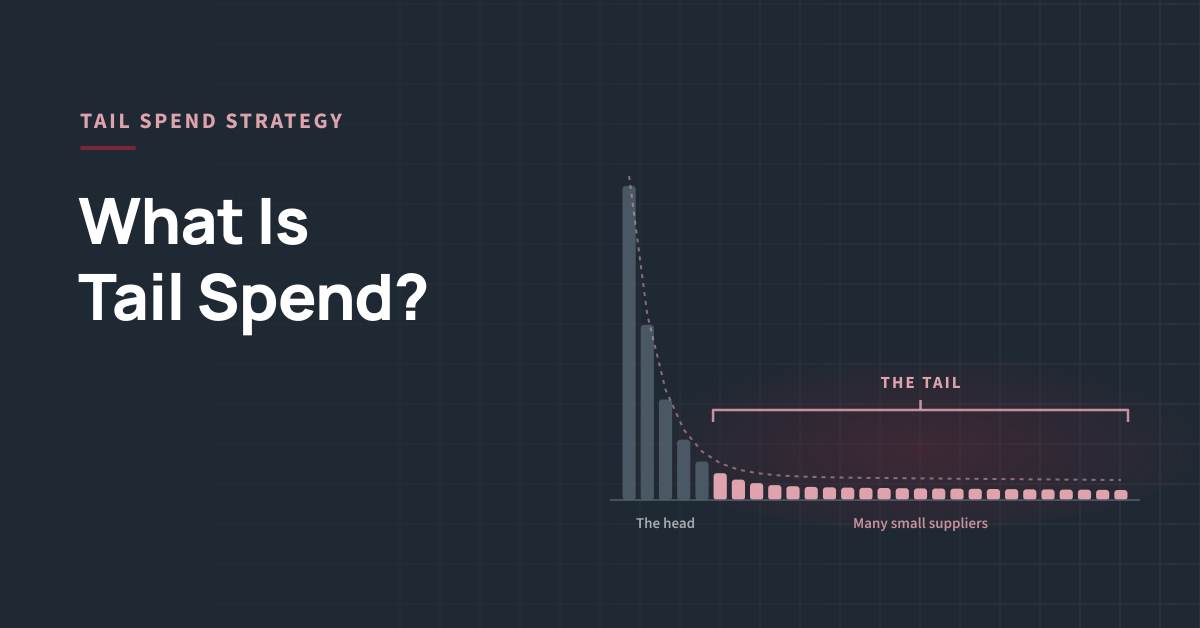
The name comes from the shape of a spend analysis chart. When you rank suppliers by how much you spend with each one, a small number of suppliers account for most of the spend. That is the “head”. After them comes a long, flat line of suppliers that each receive very little. That long line is the “tail”. Organisations usually define their tail in one of three ways, often combining them:-
- By value. Spend or suppliers below a set annual threshold count as tail.
-
- By cumulative share. Suppliers are ranked by spend, and those outside the group that makes up most of the total are treated as tail. This is often described using the 80/20 rule of thumb, but your own data should set the line.
-
- By management status. Spend that is not covered by a contract, catalogue or category strategy counts as tail, whatever its value.
Tail Spend vs Related Terms
Tail spend is often confused with other procurement terms. They overlap, but they are not the same thing.Examples of Tail Spend
What counts as tail depends on the organisation. IT hardware may be strategic for one company and tail for another. These are the categories where tail spend most often appears:Why Tail Spend Happens
Tail spend is not a sign of a badly run organisation. It grows naturally for a few reasons:-
- Many buyers. Employees across the business buy what they need for their own work, often without procurement involvement.
-
- Slow or unclear channels. When the approved route is hard to find or slow, people buy directly, on a card or through expenses.
-
- Genuine one-off needs. Some purchases really are unique and will never repeat.
-
- Too small to source. Individual purchases rarely justify a full sourcing exercise, so they are never negotiated.
-
- Scattered data. Tail transactions sit across AP, purchase orders, cards and expenses, so no one sees the full picture.
Why Tail Spend Matters
Because each purchase is small, it is easy to assume the tail does not matter. It does, for four reasons:-
- Hidden cost. Every purchase goes through the same request, approval, ordering, invoicing and payment process, whatever its value. Our guide to the real cost of tail spend breaks down these costs.
-
- Supplier upkeep. Each new supplier needs onboarding, master data and checks, even if it is used only once.
-
- Price leakage. Small purchases are usually bought at list price, without negotiation or consolidation.
-
- Risk. Tail suppliers often skip the checks applied to strategic suppliers, which creates exposure to fraud, data and compliance issues.
Is All Tail Spend Bad?
No. Some tail spend is healthy. Local suppliers, specialist providers and genuine one-off purchases all have a place, and small suppliers can bring flexibility and new ideas. The goal is not to eliminate the tail, but to make sure every tail purchase goes through a channel that fits it, with visibility, fair prices and basic checks.How Organisations Manage Tail Spend
Most organisations use one or more of four approaches:-
- Tail spend software gives your own team tools for guided buying, spot sourcing and spend visibility.
-
- Managed services add a provider’s buyers to handle requests your team cannot reach.
-
- Outsourcing transfers defined buying activity to a partner end to end.
-
- Vendor consolidation reduces the number of suppliers behind recurring categories.
Next step
See where your organisation stands. The Tail Spend Management Assessor asks four quick questions and points you to the management approach that fits your profile.